Budget
Best Jewelry for Nurses
A shift is twelve hours of gloves, alcohol gel and handwashing. The jewelry that survives it is flat, sealed and made of one material all the way through.
#ad — we earn a commission on qualifying Amazon purchases at no extra cost to you. How this site is funded. Prices are live and shown as of November 8, 2026.
The short answer
Top pick: the GEMQUEEN G23 implant-grade titanium flat-back earrings, for anyone working a twelve-hour shift - a flat back cannot catch on a mask strap, and implant-grade titanium survives repeated alcohol gel. Budget pick: the Limerencia titanium threadless flat-back studs, the cheapest implant-grade pair here. For hands, CDC guidance is explicit: “Before the surgical hand scrub, remove rings, watches and bracelets.”
The picks, ranked
| # | Pick | Material | Score | Price |
|---|---|---|---|---|
| 1 |  GEMQUEEN G23 Implant-Grade Titanium Flat Back Earrings, 18G Flat backs do not catch on mask straps or stethoscope tubing, and implant-grade titanium shrugs off alcohol gel Top pick | G23 implant-grade titanium flat-back (labret) earrings, 18G.Best overall | 9.4/10 | |
| 2 |  Limerencia Titanium Threadless Flat Back Earring Studs The cheapest implant-grade flat-back here, which makes a spare set at the locker trivially affordable Budget pick | Titanium threadless flat-back earring studs.Cheapest implant grade | 8.4/10 | $8.99 - View on Amazon $9.99 10% off |
| 3 | 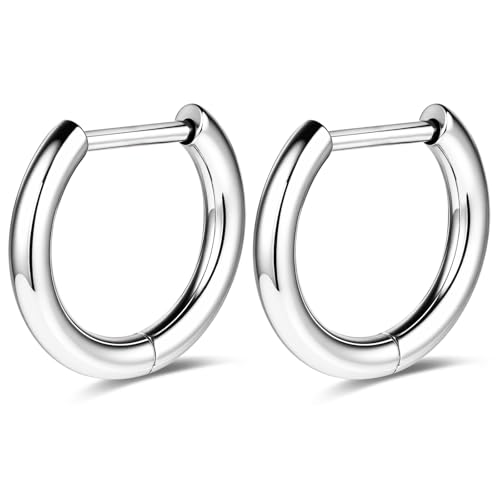 BodyAce F136 Titanium Huggie Hoop Sleeper Earrings, 18G Sleepers explicitly sold to stay in through sleep and showers - the shape that survives a night rotation | ASTM F136 implant-grade titanium hinged huggie hoops, 18G (1.0mm) at a 10mm inner diameter. Nickel-free by specification rather than by an unregulated hypoallergenic claim.Best sleep-in hoops | 9.5/10 | |
| 4 |  Gotumo G23 Titanium Threadless Flat Back Earrings, 20G Threadless titanium for cartilage and tragus, where material genuinely decides whether it heals | G23 titanium threadless flat-back studs, 20G, for lobe, tragus, cartilage and labret placements.Best for cartilage | 8.8/10 | |
| 5 |  Limerencia G23 Implant-Grade Titanium Stud Earrings, 20G The plainest implant-grade stud there is - nothing to catch, nothing to react to | G23 titanium, described by the listing as F136 implant grade. ASTM F136 is the standard for titanium alloy used in surgical implants - it is a real specification, not a marketing word, and it is nickel-free.Best plain studs | 9.6/10 | |
| 6 |  TIGRADE 4mm Titanium Polished Dome Band A slim uncoated band for off-shift, light enough to forget and cheap enough to leave in a locker | Titanium in a 4mm polished dome with comfort fit, sizes from 3. Same unnamed-grade caveat as the wider band: titanium by composition, not by published standard.Best off-shift band | 8.1/10 | |
| 7 |  TenKa 316L Stainless Steel Cross Pendant Necklace The listing names 316L rather than 'stainless steel' - worn under scrubs, where nothing touches it | 316L stainless steel. 316L is the marine-grade alloy - the listing naming the grade is meaningful, because most steel jewelry does not.Best pendant | 8.6/10 | |
| 8 |  925 Silver Earring Backs, 18K White Gold Plated, 12 Pieces Replacement backs for studs whose cheap originals failed, which is the commonest reason a pair is lost | 925 sterling silver earring backs with an 18K white gold plating. The backs are sterling; the white finish is plated.Best spare backs | 8.1/10 |

What a shift actually does to jewelry
Most jewelry advice assumes a day that involves a desk and an evening. A clinical shift is a different environment and it attacks jewelry in four specific ways, each of which rules out a different category of product.
Gloves, repeatedly. Gloving and de-gloving dozens of times a day puts a shearing force on anything that stands proud of the skin, and anything with an edge risks the glove itself. Alcohol gel and repeated handwashing. Hand hygiene performed properly means a great many exposures per shift to alcohol and soap, which strips coatings far faster than ordinary wear. Snag risk. Mask straps, stethoscope tubing, lanyards, bed rails and patient hair all catch on protruding earrings. Twelve hours without removal. Anything slightly uncomfortable in hour one is unwearable by hour nine.
Put those together and the specification writes itself: flat, sealed, one material all the way through, and light. That rules out coatings of every kind, butterfly earring backs, anything with a setting that stands proud, and anything with a crevice that cannot be cleaned.
What CDC guidance actually says about rings
This is the part most pages on this topic either skip or overstate, so it is worth quoting rather than paraphrasing. CDC's clinical hand hygiene guidance for healthcare workers says: “Before the surgical hand scrub, remove rings, watches and bracelets.” That is unambiguous and specific to the surgical scrub.
On rings more generally, the same guidance says “Some studies have shown that skin underneath rings contain more germs than fingers without rings” - and then, importantly, “Further studies should determine if wearing rings increases the spread of deadly germs.” The underlying 2002 HICPAC hand hygiene guideline likewise lists ring-wearing among its unresolved issues, stating that whether wearing rings results in greater transmission of pathogens is unknown.
So the honest position is this: more organisms are found under rings, transmission is not established, and your employer's policy is the rule that actually binds you - policies vary considerably between institutions and between departments within them. This page does not tell you whether to wear a ring on shift. It tells you that if you do wear one, a plain band with no stone and no setting is the one with nowhere for anything to sit, and that if you do not, a cheap uncoated band for off-shift makes more sense than leaving an expensive one in a locker.
The specification, by piece
| Piece | What the shift does to it | What fails | What works |
|---|---|---|---|
| Earrings | Mask straps, stethoscope tubing, twelve hours unremoved | Butterfly backs, drops, anything protruding | Flat-back implant-grade titanium |
| Rings | Gloves, alcohol gel, scrubbing, employer policy | Stones, settings, any coating | A plain uncoated band - or none, per policy |
| Bracelets / watches | Named in CDC guidance for removal before the surgical scrub | Anything with a crevice or a fabric strap | Removed. Check local policy |
| Necklaces | Worn under scrubs, so almost nothing touches it | Long chains that swing forward over patients | Short, solid 316L steel |
Why flat-back titanium wins
The top pick is implant-grade titanium flat-back earrings, and it clears every line of that specification at once.
The flat disc sits flush against the back of the lobe, so there is nothing for a mask strap or a stethoscope to catch and nothing to be pushed loose during a long shift. The same property makes it the earring that can be slept in after a night rotation, which matters more than it sounds when the alternative is removing and replacing earrings while exhausted.
The material is the other half. Implant-grade titanium to ASTM F136 - the same alloy sold as G23 - contains no nickel, so repeated hand hygiene and glove powder do not provoke the lobe. It has no coating, so there is nothing for alcohol gel to strip. And because the Association of Professional Piercers names F136 among the specifications appropriate for initial piercings, the claim on the listing is a checkable one rather than a marketing phrase. The detail is in G23 implant-grade titanium.
Why “surgical steel” is the wrong thing to look for here
Of all the audiences this site writes for, nurses are the most likely to be sold “surgical steel” on the strength of the word surgical - and it is the one place the phrase misleads most.
The actual implant steel standard, ASTM F138, is titled for an alloy containing roughly 14 percent nickel. The nickel is in the title of the standard. Implant steels are used safely in surgery because the nickel is locked into a highly corrosion-resistant alloy that releases very little of it, and for most people that is genuinely fine. For someone with a diagnosed nickel allergy, on a lobe exposed to alcohol gel and glove powder all shift, it is not the guarantee the phrase implies.
“Hypoallergenic” is weaker still - it has no legal definition in jewelry at all and is applied routinely to pieces containing nickel. Neither phrase is a lie; neither is information. What hypoallergenic really means and what is surgical steel take both apart. Titanium with a named grade is the phrase that carries actual content.
The spare-backs problem
One pick on this page is not jewelry at all, and it is here because it solves the commonest way earrings are lost in this job. Cheap butterfly backs loosen, and they loosen fastest on someone who is moving constantly, pulling masks on and off, and not checking their ears for twelve hours. The earring is usually fine; the back is gone.
A set of secure replacement backs keeps pairs you already own in service and costs less than replacing one of them. Keeping a spare set in a locker is the single cheapest piece of advice on this page.
What we would actually buy
For earrings worn through shifts: the implant-grade flat-backs, which solve snagging and reaction in one product. For a second or third set, or a spare in a locker: the threadless titanium studs, which are the budget pick. For a night rotation: the titanium sleepers, which are explicitly sold to be left in.
For the neck: a short solid 316L chain under scrubs, which touches nothing all day. For a ring, if your policy allows one: a plain uncoated titanium band, with no stone and no setting, bought cheaply enough that leaving it in a locker is not a decision. And a set of spare backs, because the earrings are rarely what gets lost.
Everything on this page is chosen on construction rather than on appearance, which is the same rule the rest of this site runs on - it just has more consequences here. If your skin is the deciding factor rather than the job, jewelry for sensitive skin is the broader page, and best titanium jewelry covers the material across every format it comes in.
Every pick in detail
What each one is actually made of, how long it realistically lasts in that material, who it is for and who should skip it.
1 · Best overall
GEMQUEEN G23 Implant-Grade Titanium Flat Back Earrings, 18G
Flat backs plus implant-grade titanium is the combination piercers actually recommend, at $13 instead of studio prices.
- What it is
- G23 implant-grade titanium flat-back (labret) earrings, 18G.
- Realistic lifespan
- Effectively indefinite as a material.
- 18G
- G23 titanium
- flat back
What works
- Flat disc back is genuinely more comfortable to sleep on than a butterfly
- Implant-grade material in the style most likely to be worn 24/7
- 18G is the standard lobe gauge, so it fits most existing piercings
What does not
- Threaded backs can loosen; check them weekly
- Fiddlier to put in than a push-through stud
Skip it if: your piercing is 20G and snug. Forcing an 18G post through a 20G hole is how you irritate a healed piercing.
#ad how we make money · price as of November 8, 2026
Best for side sleepers, and anyone whose butterfly backs keep digging in. Score 9.4/10 from published specifications.
2 · Cheapest implant grade
Limerencia Titanium Threadless Flat Back Earring Studs
The cheapest implant-style flat back here at $9. Buy two - threadless ends are the thing you lose.
- What it is
- Titanium threadless flat-back earring studs.
- Realistic lifespan
- Effectively indefinite as a material.
- threadless
- titanium
- flat back
What works
- Under $10 for titanium flat backs
- Threadless means nothing to unscrew in your sleep
What does not
- Threadless ends are the single easiest piece of jewelry to lose
- Listing does not restate the ASTM grade the brand's other lines cite
Skip it if: you want the grade printed on the listing. The GEMQUEEN G23 set states it explicitly for a few dollars more.
Best for a spare set, or a first try at flat backs. Score 8.4/10 from published specifications.
3 · Best sleep-in hoops
BodyAce F136 Titanium Huggie Hoop Sleeper Earrings, 18G
F136 titanium sleepers under $10, from a listing that names the standard in its own title. The cheapest way to stop reacting to your earrings.
- What it is
- ASTM F136 implant-grade titanium hinged huggie hoops, 18G (1.0mm) at a 10mm inner diameter. Nickel-free by specification rather than by an unregulated hypoallergenic claim.
- Realistic lifespan
- Effectively indefinite as a material. There is no plating to wear through.
- 18G / 1.0mm
- ASTM F136
- hinged D-shape
What works
- Implant-grade standard named on the listing, at an impulse-buy price
- Sold as continuous-wear jewelry - sleep and bathe in them, which is the point for reactive ears
What does not
- Very small - a 10mm D-shape hoop reads as a detail, not a statement
- One diameter per listing: 8mm, 10mm and 12mm are separate variants, so pick the size before ordering
- The hinge is the only moving part, and the only thing on a huggie that can fail
Skip it if: you want your earrings to be seen across a room. A 10mm huggie disappears into the lobe - which is exactly why it can stay there.
#ad how we make money · price as of November 8, 2026
Best for leaving in permanently - the listing is explicit that they stay in through sleep and showers. Score 9.5/10 from published specifications.
4 · Best for cartilage
Gotumo G23 Titanium Threadless Flat Back Earrings, 20G
Threadless titanium at 20G - the gauge and material most piercers put in a healed cartilage piercing.
- What it is
- G23 titanium threadless flat-back studs, 20G, for lobe, tragus, cartilage and labret placements.
- Realistic lifespan
- Effectively indefinite as a material.
- 20G
- G23 titanium
- threadless
What works
- Threadless posts have no threads to abrade a piercing channel
- Implant-grade titanium in the placements that are fussiest about metal
What does not
- Threadless ends can pop out if the post is not bent to tension correctly
- Fiddly for anyone new to flat backs
Skip it if: your piercing is brand new and still healing under a piercer's care. Follow their downsizing schedule, not a multipack.
#ad how we make money · price as of November 8, 2026
Best for cartilage and tragus piercings, where material actually decides whether it heals. Score 8.8/10 from published specifications.
5 · Best plain studs
Limerencia G23 Implant-Grade Titanium Stud Earrings, 20G
The one honest answer to 'my ears react to everything'. F136 is a published standard, unlike the word hypoallergenic.
- What it is
- G23 titanium, described by the listing as F136 implant grade. ASTM F136 is the standard for titanium alloy used in surgical implants - it is a real specification, not a marketing word, and it is nickel-free.
- Realistic lifespan
- Effectively indefinite. Titanium does not tarnish, does not corrode and has no coating to lose.
- 20G
- G23 / F136
- nickel-free
What works
- Cites an actual ASTM standard rather than the unregulated word 'hypoallergenic'
- Nickel-free by specification - the only claim on this site that removes the question entirely
- Under $10, which makes the safe choice also the cheap one
What does not
- Titanium's gray tone is cooler and flatter than silver
- 20G posts are thinner than standard earring posts; check your piercing gauge
Skip it if: you want warm-toned metal. Titanium is gray, and no finish on a $10 earring changes that permanently.
#ad how we make money · price as of November 8, 2026
Best for ears that react to steel, sterling, gold-plate and everything else. Score 9.6/10 from published specifications.
6 · Best off-shift band
TIGRADE 4mm Titanium Polished Dome Band
The slim version of the same argument - light enough to forget, cheap enough to own alongside a real wedding ring.
- What it is
- Titanium in a 4mm polished dome with comfort fit, sizes from 3. Same unnamed-grade caveat as the wider band: titanium by composition, not by published standard.
- Realistic lifespan
- Decades. A narrow band flexes less than a wide one and titanium holds its shape well.
- 4mm width
- comfort fit
- sizes from 3
What works
- A 4mm titanium band is barely perceptible in weight - the closest thing to not wearing a ring
- No plating, no nickel in the base specification, no green finger
- Priced low enough to be a travel stand-in for an expensive ring
What does not
- Narrow polished bands show scratches sooner than wide matte ones
- Grade unpublished, so it is not a substitute for a certified implant-grade piece
- Cannot be resized
Skip it if: you want a band with presence. At 4mm this is a quiet ring, and it will disappear next to anything ornate.
#ad how we make money · price as of November 8, 2026
Best for a slim band, or a stacking ring that will not green a finger. Score 8.1/10 from published specifications.
7 · Best pendant
TenKa 316L Stainless Steel Cross Pendant Necklace
The listing names 316L rather than saying 'stainless steel'. That specificity is worth more than the price difference.
- What it is
- 316L stainless steel. 316L is the marine-grade alloy - the listing naming the grade is meaningful, because most steel jewelry does not.
- Realistic lifespan
- Effectively indefinite. 316L is the grade used for surgical instruments and boat fittings precisely because it resists corrosion.
- 316L grade
- cross pendant
- bold
What works
- The steel grade is actually published - rare at this price
- 316L is the most corrosion-resistant common jewelry steel
What does not
- 316L still contains nickel, bound in the alloy - low-release, not nickel-free
- A bold pendant is a style commitment
Skip it if: you have a diagnosed nickel allergy. 316L releases very little nickel, but 'very little' is not 'none' - titanium is the zero option.
#ad how we make money · price as of November 8, 2026
Best for a pendant worn in salt water, chlorine or sweat without a second thought. Score 8.6/10 from published specifications.
8 · Best spare backs
925 Silver Earring Backs, 18K White Gold Plated, 12 Pieces
Replacement backs in a real material, for the earrings whose original backs you lost. Unglamorous and genuinely useful.
- What it is
- 925 sterling silver earring backs with an 18K white gold plating. The backs are sterling; the white finish is plated.
- Realistic lifespan
- The sterling is indefinite. The white plating is thin and will wear, exposing sterling that then tarnishes - on a back nobody sees.
- 12 pieces
- 925 sterling
- plated finish
What works
- Sterling backs on earrings whose posts you already trust
- Twelve pieces covers years of losses
What does not
- Backs do not fix a post you react to - the post is what sits in the hole
- Plating on a back is cosmetic and pointless; you are buying the sterling
Skip it if: you react to your earrings. The reaction is almost always the post, not the back - change the earring, not the fastener.
#ad how we make money · price as of November 8, 2026
Best for rescuing good earrings whose cheap backs failed. Score 8.1/10 from published specifications.
Common questions
Can nurses wear rings at work?
It depends on your employer's policy, which is the rule that actually binds you. CDC guidance is explicit for one case - “Before the surgical hand scrub, remove rings, watches and bracelets” - and notes that “skin underneath rings contain more germs than fingers without rings”, while also stating that further studies are needed to determine whether wearing rings increases the spread of dangerous germs. Where a ring is permitted, a plain band with no stone and no setting has the fewest places for anything to sit.
What earrings are best for a 12-hour shift?
Flat-back studs in implant-grade titanium. The flat disc sits flush so nothing can catch on a mask strap or stethoscope tubing, and it can be slept in after a night shift. Implant-grade titanium contains no nickel and has no coating, so repeated alcohol gel and handwashing do not affect it.
Does hand sanitizer damage jewelry?
It damages coatings, not solid metals. Repeated alcohol exposure strips plated finishes considerably faster than ordinary wear, which is why gold-plated pieces fail quickly in clinical work. Solid titanium, solid 316L steel and solid sterling are unaffected by it, though sterling still tarnishes on its usual schedule and needs occasional polishing.
Is surgical steel jewelry safe for nurses with nickel allergy?
Not reliably. The implant steel standard ASTM F138 is titled for an alloy containing roughly 14 percent nickel - the nickel is named in the standard itself. Implant steels release very little of it and are fine for most people, but for a diagnosed nickel allergy on skin that is repeatedly stripped by hand hygiene, titanium with a named grade such as G23 or ASTM F136 is the safer choice.
What necklace can you wear under scrubs?
A short, solid chain - 316L stainless steel or sterling - worn under the top so it is not exposed and does not swing forward over a patient. Length matters more than material for practical purposes: a long chain is the one that gets in the way. Solid metal matters because plating does not survive repeated washing.
Why do my earrings keep falling out at work?
Almost always the back rather than the earring. Butterfly clutches loosen with movement, and a shift involves a great deal of it plus masks being pulled on and off past the ears. Flat-back or screw-back styles solve it structurally; a set of secure replacement backs rescues pairs you already own and costs less than replacing one.
Sources
Every specification and figure on this page traces to one of these. Where a source does not publish a number, the page says so rather than estimating one.
- CDC - Clinical Safety: Hand Hygiene for Healthcare Workers — The federal guidance in its own words: 'Before the surgical hand scrub, remove rings, watches and bracelets', and 'Some studies have shown that skin underneath rings contain more germs than fingers without rings' - followed by 'Further studies should determine if wearing rings increases the spread of deadly germs.'
- CDC / HICPAC - Guideline for Hand Hygiene in Health-Care Settings (MMWR 2002) — The underlying guideline. It lists ring-wearing among its unresolved issues: whether wearing rings results in greater transmission of pathogens is stated as unknown.
- ASTM F136 - Wrought Ti-6Al-4V ELI alloy for surgical implant applications — The standard behind 'implant grade' titanium. A listing that names it is making a checkable claim.
- ASTM F138 - Wrought 18Chromium-14Nickel-2.5Molybdenum stainless steel for surgical implants — The actual implant-steel standard (UNS S31673). Its own title states the nickel content, which is why 'surgical steel' cannot mean nickel-free.
- Association of Professional Piercers - jewelry for initial piercings — Names the standards the APP considers appropriate: ASTM F-138 / ISO 5832-1 for steel, and ASTM F-136, F1295, ISO 5832-3 or F-67 for titanium.
- voestalpine - 316L (UNS S31603) alloy datasheet — Mill datasheet giving the 316L composition range quoted on this site: 16.0-18.0% chromium, 10.0-14.0% nickel, 2.0-3.0% molybdenum.
- 16 CFR 23.3 - Misrepresentation as to gold content (FTC Jewelry Guides) — Defines the gold-plate minimum (0.175 microns), heavy gold electroplate (2.5 microns) and the gold-filled 1/20th-by-weight threshold.
Read next
- Best titanium jewelry
The material that wins this page, across every format it comes in.
- What is surgical steel
Why the most reassuring phrase in the aisle is not a nickel-free guarantee.
- Flat back earrings
The shape in detail, including how threadless and labret posts go in.
- Jewelry for sensitive skin
The broader page, if skin rather than the job is the deciding factor.