Budget
Best Stacking Rings
Stacked rings are the only jewelry that damages itself. Everything on this page is ranked on how it survives the ring sitting next to it.
#ad — we earn a commission on qualifying Amazon purchases at no extra cost to you. How this site is funded. Prices are live and shown as of November 8, 2026.
The short answer
Top pick: the TIGRADE 4mm titanium polished dome band, for anyone building a stack they intend to keep - titanium is hard enough not to be chewed up by whatever sits next to it, and it has no coating to grind off. Budget pick: the TIGRADE stainless steel half-CZ eternity band, the cheapest band here that survives being stacked. Buy bands of similar hardness, or the softer one loses.
The picks, ranked
| # | Pick | Material | Score | Price |
|---|---|---|---|---|
| 1 |  TIGRADE 4mm Titanium Polished Dome Band Hard, light and uncoated - the band that neither damages its neighbors nor gets damaged by them Top pick | Titanium in a 4mm polished dome with comfort fit, sizes from 3. Same unnamed-grade caveat as the wider band: titanium by composition, not by published standard.Best overall | 8.1/10 | |
| 2 |  TIGRADE 3.5mm Half-CZ Stainless Steel Eternity Band Solid steel with stones set below the rail, for the cheapest band here that survives a stack Budget pick | Solid stainless steel band, 3.5mm, channel-set with cubic zirconia over part of the circumference. No coating - the silver color is the metal itself. The listing does not name the steel grade.Cheapest stackable band | 7.6/10 | |
| 3 |  TIGRADE 2mm Titanium CZ Eternity Ring A 2mm titanium band, which is slim enough to stack three deep without bulk | Solid titanium band, 2mm, set with cubic zirconia. Titanium is an element rather than an alloy family, so a titanium band contains no nickel by composition. The listing does not publish a grade.Best slim band | 7.4/10 | |
| 4 | 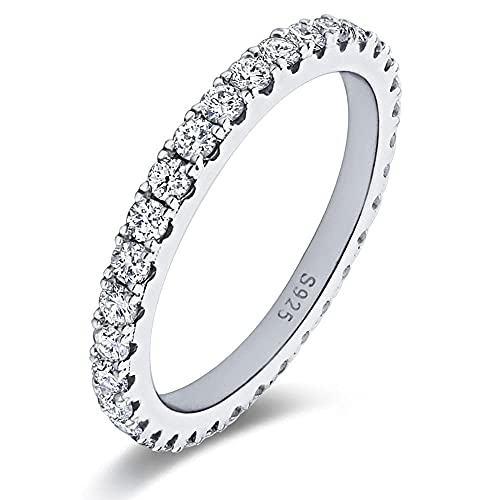 Bo.Dream 925 Sterling Silver CZ Eternity Band, 2.2mm Real sterling rather than plating, which is what makes a stack resizable and repairable | 925 sterling silver eternity band set with cubic zirconia, 2.2mm.Best sterling band | 7.6/10 | |
| 5 |  JeryWe Stainless Steel Stackable Knuckle Ring Set, 6 Pieces Six solid steel rings at once - the cheap way to find out which widths you actually wear | Stainless steel stacking and knuckle rings, six pieces. Solid steel, no coating.Best starter set | 8.5/10 | |
| 6 |  EAMTI 3mm CZ Half Eternity Band, 925 Sterling Silver Stones on the top half only, so the palm side is plain metal and the ring can be resized | 925 sterling silver band, 3mm wide, set with round cubic zirconia across roughly the top half of the ring. The back of the band is plain solid metal.Best half eternity | 7.9/10 | |
| 7 | 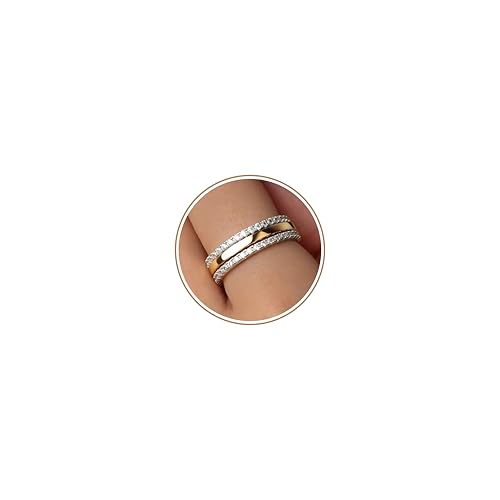 Purplepig Two-Tone Stackable CZ Eternity Band Set, 3 Rings A two-tone set that is a plated finish over brass, included as the counter-example it is | Three thin bands - two silver-tone CZ eternity bands and one plain gold-tone band - marketed as non-tarnish. The listing does name the construction, and it is worth reading carefully: brass, with sterling silver plating on the silver bands and 14K gold plating on the gold one. The metal you can see is a coating. The metal you own is brass.Best two-tone look | 6.3/10 |
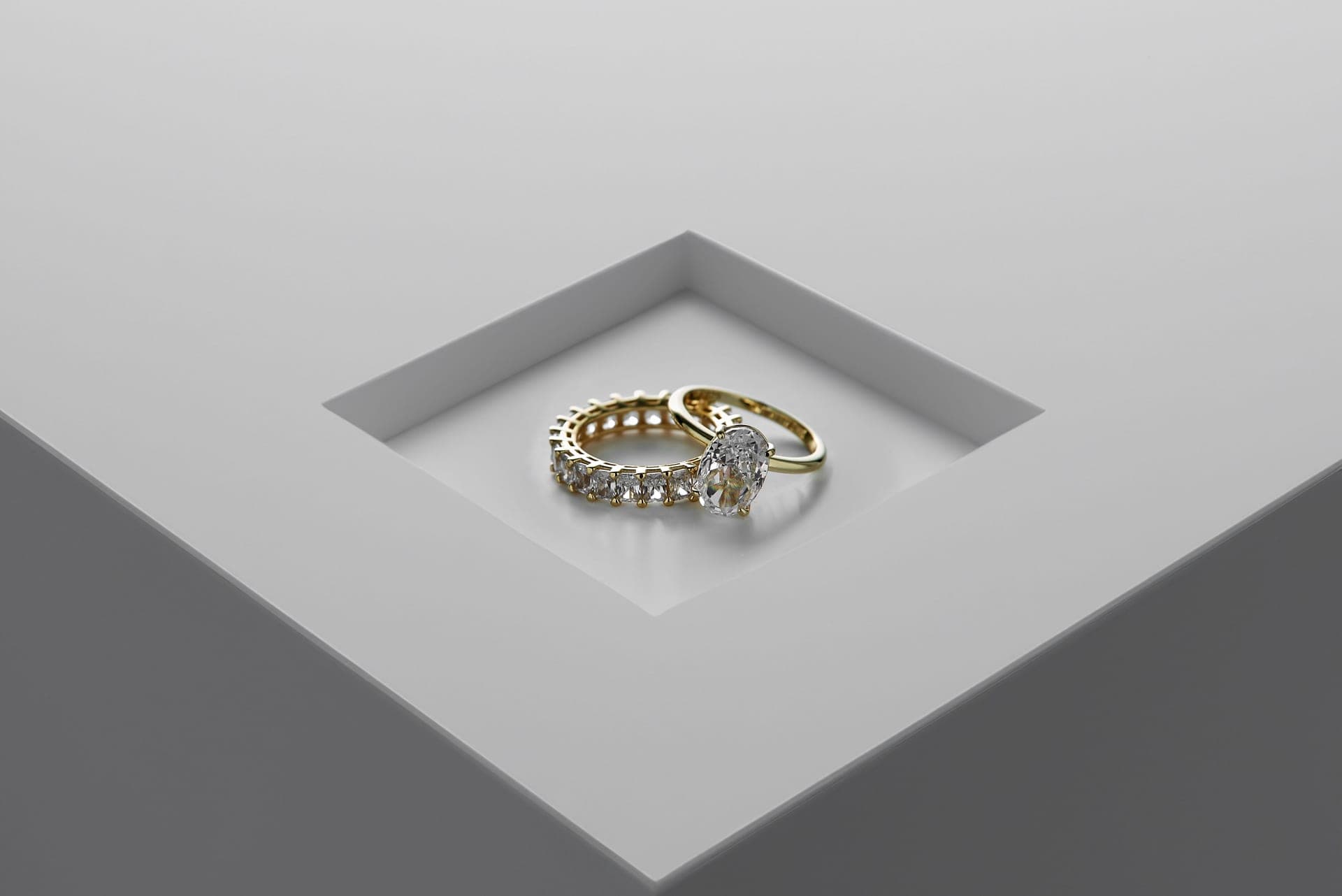
Stacked rings are the only jewelry that attacks itself
Every other piece of jewelry wears out because of what the world does to it. A chain meets fabric, a bracelet meets a desk, a single ring meets a steering wheel. A stack of rings has all of that plus one failure mode that belongs to it alone: the rings grind against each other, continuously, every time the hand moves, for as long as they are worn together.
That is not a small effect and it is not slow. Two bands sharing a finger are in constant contact along their facing edges, and unlike contact with a desk, this contact is metal on metal with nothing to cushion it. The result over a year of daily wear is visible, and the pattern is always the same: whichever band is softer loses. It develops a bright worn edge, then a flattened one, and if it has a coating the coating goes first and goes completely.
Which means the question for a stack is not “is this ring durable”. It is “is this ring durable relative to the one next to it”, and that is a question no listing answers and no other roundup asks. It is the axis this page is ranked on.
Hardness, ranked
| Metal | Relative hardness | In a stack with softer metal | In a stack with harder metal |
|---|---|---|---|
| Titanium (CP Grade 2) | High. Vickers around 145 for commercially pure | Wins. It will mark the softer band | Holds up well. Few jewelry metals are harder |
| Stainless steel (316L) | High, and similar to titanium in practice | Wins against sterling and anything plated | Fine alongside titanium - a sound pairing |
| Sterling silver | Low. The softest common ring metal | Only wins against plated brass | Loses. Visible flattening within a year |
| Plated brass | Low, and the coating is the problem | Loses to everything, including itself | The coating goes first, then the brass shows |
Read down the last two columns and the rule falls out: build a stack from metals of similar hardness. Three titanium bands work. Titanium plus steel works. Sterling plus sterling works, because they wear evenly against each other. Titanium next to a plated band is the pairing that disappoints, and it disappoints fastest, because it combines the hardest common option with the only one that has something on its surface to lose.
Why plain titanium tops the page
The top pick is a 4mm polished titanium dome band, and it earns the slot by being good at the specific job rather than by being the most interesting ring here. It is hard, so it survives whatever it is stacked with. It has no coating, so there is no finish to be ground off at the contact edges. It contains no nickel, which matters when three bands are concentrating contact on one patch of skin. And it is light - a stack of three titanium bands weighs less than one steel one, which is the difference between a stack you wear and a stack you take off by lunchtime.
The honest limitation, and it is a real one: titanium cannot be resized. No jeweler will cut and rejoin it the way they will gold or sterling. For a stack that is bought as a set and worn as a set, that is rarely a problem. For a ring that has to adapt to a finger over fifteen years, it is the argument for sterling instead, which is also why the sterling eternity band is on this page rather than being excluded on hardness grounds.
Eternity bands are the stacking shape
Four of the seven picks are eternity or half-eternity bands, and that is not a coincidence. A stone set flush into or below the rail of a band adds visual interest without adding height, and height is what makes a stack snag. A solitaire in a stack catches on everything and scratches the band beside it with its own setting. A flush or channel-set eternity band stacks flat.
The one thing to understand before buying a full eternity band - and it is the single most common regret in the category - is that a full eternity band cannot be resized at all. Not slightly, not by a good jeweler, not ever, because the stones run the entire circumference and there is no plain metal to cut. Buy the size you will be. If your fingers change size seasonally, or you are buying as a gift, a half-eternity band gives you the same look from the top with plain metal on the palm side that a jeweler can work with. That whole argument, across four metals, is in best eternity bands.
Starter sets: buy cheap, learn, then buy properly
There is a sensible case for starting with a multi-ring set rather than agonizing over one band. Nobody knows in advance how many rings they will actually wear, on which fingers, at what widths - and the only way to find out is to wear them for a month. A six-piece solid steel set costs less than a single mid-range band and answers that question properly.
The important detail is that the set be solid metal. A set bought to be experimented with will be stacked badly, mixed with everything, and worn through things it should not be. Solid steel survives that; a plated set does not, and a plated set that fails in month two teaches you nothing except that plating fails.
The two-tone set, and why it is here as a counter-example
The last pick is included with its construction named rather than quietly left off, because it is the best illustration on this page of the thing the page is about. It is sold into “sterling silver stacking rings” searches, it is genuinely attractive, and it is a plated finish over a base metal rather than solid sterling.
That makes it the single worst construction to stack with hard metal, and a reasonable purchase in exactly one scenario: a two-tone look, worn as its own group, for a season or two, at a price where replacing it is not a decision. Bought that way it is good value. Bought as the sterling it is marketed alongside, and stacked next to titanium, it will look chewed within months. The distinction is worth reading properly in sterling silver vs silver plated.
How to build a stack that lasts
Three rules, in order of how much they matter. First, match hardness: pick a tier - hard metals or soft metals - and stay in it. Second, keep the profiles low: flat, domed and flush-set bands stack; anything that stands proud snags and scratches. Third, vary width rather than height, because a 2mm band next to a 4mm band reads as deliberate while two identical bands read as an accident.
And one practical note that is not about metal at all: stacks are worn on fingers that change size. Rings that fit perfectly in January are tight in July. A stack is more sensitive to this than a single ring, because three snug bands are considerably less forgiving than one. Sizing up by a quarter on at least one band in the stack is the cheapest insurance there is, and how to find ring size covers doing it properly.
What we would actually buy
For a stack built to last: three titanium bands in different widths, which is light, hard, nickel-free and internally consistent. For one band to anchor a stack of mixed metals: the titanium dome, because it is the one that will not be the loser in any pairing. For a first experiment: the six-piece steel set, worn for a month to find out what you actually like. For something that has to be resizable and repairable over decades: the sterling eternity band, accepting that it will wear faster than the hard metals around it and that polishing is part of owning it.
Every pick in detail
What each one is actually made of, how long it realistically lasts in that material, who it is for and who should skip it.
1 · Best overall
TIGRADE 4mm Titanium Polished Dome Band
The slim version of the same argument - light enough to forget, cheap enough to own alongside a real wedding ring.
- What it is
- Titanium in a 4mm polished dome with comfort fit, sizes from 3. Same unnamed-grade caveat as the wider band: titanium by composition, not by published standard.
- Realistic lifespan
- Decades. A narrow band flexes less than a wide one and titanium holds its shape well.
- 4mm width
- comfort fit
- sizes from 3
What works
- A 4mm titanium band is barely perceptible in weight - the closest thing to not wearing a ring
- No plating, no nickel in the base specification, no green finger
- Priced low enough to be a travel stand-in for an expensive ring
What does not
- Narrow polished bands show scratches sooner than wide matte ones
- Grade unpublished, so it is not a substitute for a certified implant-grade piece
- Cannot be resized
Skip it if: you want a band with presence. At 4mm this is a quiet ring, and it will disappear next to anything ornate.
#ad how we make money · price as of November 8, 2026
Best for a slim band, or a stacking ring that will not green a finger. Score 8.1/10 from published specifications.
2 · Cheapest stackable band
TIGRADE 3.5mm Half-CZ Stainless Steel Eternity Band
The band for someone who will not take a ring off for anything. Nothing on it can tarnish or wear off, and it costs less than a takeout dinner.
- What it is
- Solid stainless steel band, 3.5mm, channel-set with cubic zirconia over part of the circumference. No coating - the silver color is the metal itself. The listing does not name the steel grade.
- Realistic lifespan
- The metal is effectively permanent: steel does not tarnish and has no finish to wear through. The CZ still clouds on the same 2-5 year timescale as any other CZ.
- 3.5mm
- stainless steel
- no coating
What works
- No plating means there is no finish to lose - this ring looks the same in year five
- Steel shrugs off the scratches that leave sterling looking dull
- Sized 3 to 12.5, which is a wider range than most budget bands offer
What does not
- Steel rings cannot be resized at all - the metal will not take solder the way sterling does
- The steel grade is not published, so the nickel content is unknown
- Channel-set CZ in steel cannot be re-set when it clouds; the stones are the ring's lifespan
Skip it if: your finger size is unsettled, or your ears and wrists react to cheap metal. An unnamed steel grade is an unanswered nickel question.
#ad how we make money · price as of November 8, 2026
Best for hands-on work, water and total neglect. Score 7.6/10 from published specifications.
3 · Best slim band
TIGRADE 2mm Titanium CZ Eternity Ring
The slimmest band on this page and the only one whose metal answers the nickel question by what it is rather than by what the seller claims.
- What it is
- Solid titanium band, 2mm, set with cubic zirconia. Titanium is an element rather than an alloy family, so a titanium band contains no nickel by composition. The listing does not publish a grade.
- Realistic lifespan
- The metal is permanent and will not corrode in sweat, chlorine or salt water. The CZ is the wear item, as on every CZ ring here.
- 2mm
- titanium
- nickel-free by composition
What works
- Titanium is nickel-free because of what the metal is, not because a listing says hypoallergenic
- 2mm is genuinely slim, so it stacks with a wider band without looking heavy
- Lighter on the finger than steel or sterling at the same width
What does not
- Titanium cannot be resized or soldered, so the size you order is permanent
- No grade published - commercially pure titanium and Ti-6Al-4V are both sold as 'titanium'
- A 2mm band is easy to lose track of; this is a quiet ring, not a statement
Skip it if: you want a ring a jeweler can alter later. Titanium is the least repairable metal on this page.
#ad how we make money · price as of November 8, 2026
Best for reactive skin, and stacking without bulk. Score 7.4/10 from published specifications.
4 · Best sterling band
Bo.Dream 925 Sterling Silver CZ Eternity Band, 2.2mm
A real-silver eternity band at $30. The stones are the countdown; the metal is not, and you can have it re-set.
- What it is
- 925 sterling silver eternity band set with cubic zirconia, 2.2mm.
- Realistic lifespan
- The sterling is indefinite. The CZ stones cloud over 2-5 years of daily wear, and eternity bands are the worst case because the stones wrap the whole finger and meet everything.
- 2.2mm
- 925 sterling
- eternity setting
What works
- Sterling rather than plated - the band is worth keeping when the stones dull
- Slim 2.2mm stacks well with other rings
What does not
- Eternity settings expose stones on all sides - the highest-abrasion stone layout there is
- Sterling prongs are soft and need occasional checking
Skip it if: you work with your hands. An eternity band takes hits from every angle; a plain band takes none.
#ad how we make money · price as of November 8, 2026
Best for a stacking band or a wedding-band alternative in real metal. Score 7.6/10 from published specifications.
5 · Best starter set
JeryWe Stainless Steel Stackable Knuckle Ring Set, 6 Pieces
Six steel rings for $14. The correct material for the item that gets abused the most, at the price of a sandwich.
- What it is
- Stainless steel stacking and knuckle rings, six pieces. Solid steel, no coating.
- Realistic lifespan
- Effectively indefinite for the metal. Rings live the hardest life of any jewelry and steel is the material that ignores it.
- 6 pieces
- stainless steel
- stackable
What works
- Steel is the right answer for rings and almost nobody says so
- Six pieces at this price means you can lose one without caring
What does not
- Not resizable - steel rings are what size they are
- Multipack sizing means some will not fit
Skip it if: you need one specific size. Buy a single ring in your size instead of a set with a lottery in it.
#ad how we make money · price as of November 8, 2026
Best for a stack you actually wear rather than one you protect. Score 8.5/10 from published specifications.
6 · Best half eternity
EAMTI 3mm CZ Half Eternity Band, 925 Sterling Silver
The shape that fixes the one real flaw in eternity bands. Plain metal across the palm side means a jeweler can size it, and the stones are not grinding against door handles all day.
- What it is
- 925 sterling silver band, 3mm wide, set with round cubic zirconia across roughly the top half of the ring. The back of the band is plain solid metal.
- Realistic lifespan
- The sterling is indefinite and, unlike a full eternity band, resizable. The CZ is the clock: cubic zirconia clouds over roughly 2-5 years of daily wear as its surface takes micro-abrasion.
- 3mm
- 925 sterling
- half eternity
What works
- Half-eternity is resizable - the band has plain metal to cut and rejoin, which a full eternity band does not
- Stones sit on the visible half only, so the palm side takes the knocks instead of the settings
- Solid 925 rather than plated, so the band is worth re-setting when the CZ dulls
What does not
- CZ clouds; plan on the stones looking tired years before the metal does
- 3mm is wider than a stacking band, so it crowds other rings on the same finger
- Sterling prongs are soft and want checking once a year if you wear it daily
Skip it if: you want stones visible from every angle. That is a full eternity band, and you are trading away resizing to get it.
#ad how we make money · price as of November 8, 2026
Best for an eternity look on a finger whose size might change. Score 7.9/10 from published specifications.
7 · Best two-tone look
Purplepig Two-Tone Stackable CZ Eternity Band Set, 3 Rings
A cheap, good-looking stack, and the listing is honest enough to say it is plated brass. Price it as a season or two, not as jewelry you keep.
- What it is
- Three thin bands - two silver-tone CZ eternity bands and one plain gold-tone band - marketed as non-tarnish. The listing does name the construction, and it is worth reading carefully: brass, with sterling silver plating on the silver bands and 14K gold plating on the gold one. The metal you can see is a coating. The metal you own is brass.
- Realistic lifespan
- Plating on a ring is the shortest-lived finish in jewelry. Rings take the hardest life of anything you wear - keys, gym bars, washing up - and at under 2g a band there is very little plating to lose. Plan on 6 months to 2 years before the high points go back to brass.
- 3-ring set
- plated brass
- AAAAA CZ
What works
- A full coordinated stack for the price of one ring elsewhere
- Two-tone means it works with both silver and gold pieces
- The base metal is actually named, which is more than most listings in this tier manage
What does not
- Brass under the plating - when the coating wears through on a ring, brass is what meets your finger
- 'Non-tarnish' is a marketing claim here, not a material specification: the plating does not tarnish, and then it is not there
- Nickel-free and 'no green discoloration' are claimed without naming a standard, so neither is checkable
Skip it if: your fingers react to costume jewelry. Buy the sterling eternity band instead, where the metal goes all the way through.
#ad how we make money · price as of November 8, 2026
Best for a low-stakes stack you are happy to replace. Score 6.3/10 from published specifications.
Common questions
Do stacking rings damage each other?
Yes, and it is the main way they wear out. Two bands on one finger are in constant metal-on-metal contact along their facing edges whenever the hand moves. The softer band loses - it develops a bright worn edge and then a flattened one - and if it is plated, the coating goes first and goes entirely. Matching hardness across a stack is the single most useful thing you can do.
What metal is best for stacking rings?
Titanium and stainless steel, which are hard, uncoated and similar enough to each other to stack together safely. Sterling silver works well in a stack of sterling, because the bands wear evenly against each other, but it is the softest common ring metal and will lose to anything harder. Plated anything is the one to keep out of a mixed stack.
How many rings can you stack on one finger?
Two or three is what most people actually wear comfortably. The limit is set by the total height against the adjacent knuckle rather than by taste. Slim bands of 2mm stack three deep comfortably; 4mm bands usually stop at two. Vary width rather than stacking identical bands - it reads as deliberate instead of accidental.
Can stacking rings be resized?
Sterling and solid gold can be. Titanium, tungsten and stainless steel cannot - they are too hard for a jeweler to cut and rejoin. A full eternity band cannot be resized in any metal, because the stones run the whole circumference and there is no plain section to work with. A half-eternity band in sterling is the shape that keeps the option open.
Should stacking rings all be the same metal?
Not necessarily the same metal, but the same hardness tier. Titanium with steel is a sound mixed stack. Titanium with plated brass is the pairing that disappoints quickly. Mixed metal tones - silver with gold tone - look deliberate and are entirely a matter of taste; mixed hardness is the part that has consequences.
Sources
Every specification and figure on this page traces to one of these. Where a source does not publish a number, the page says so rather than estimating one.
- NeoNickel - Titanium CP3 Grade 2 datasheet — Commercially pure titanium: density 4.51 g/cm3, Vickers hardness 145, and a composition table listing only C, N, O, H, Fe and Ti - nickel does not appear.
- voestalpine - 316L (UNS S31603) alloy datasheet — Mill datasheet giving the 316L composition range quoted on this site: 16.0-18.0% chromium, 10.0-14.0% nickel, 2.0-3.0% molybdenum.
- 16 CFR 23.5 - Misrepresentation as to silver content — 'Sterling' requires at least 925/1000ths pure silver; 'coin silver' at least 900/1000ths.
- 16 CFR 23.3 - Misrepresentation as to gold content (FTC Jewelry Guides) — Defines the gold-plate minimum (0.175 microns), heavy gold electroplate (2.5 microns) and the gold-filled 1/20th-by-weight threshold.
- Copper Development Association - alloy C26000 (cartridge brass) — The CDA's own classification of the commonest brass: wrought, family 'Copper-Zinc Alloys (Yellow Brasses)'. Brass is copper plus zinc - the copper is the part that reacts with skin.
Read next
- Best eternity bands
The shape that stacks best, and the resizing problem that comes with it.
- Best sterling silver rings
The soft-metal half of this page, argued on repairability instead.
- Best titanium jewelry
The material that wins this page, across every format it comes in.
- How to find ring size
Stacks are less forgiving than single rings. Measure before you buy.