Care
How to Store Jewelry
Every polish removes a little silver. Storage is the only part of jewelry care that costs you nothing.
#ad — we earn a commission on qualifying Amazon purchases at no extra cost to you. How this site is funded. Prices are live and shown as of September 18, 2026.
The short answer
Silver tarnishes by reacting with airborne sulfur compounds, so the fix is to exclude air: store each piece separately, dry, in a closed container with an anti-tarnish tab. Chains hang or lie flat. Pearls and opals need air and go in cloth, never sealed plastic.
What to buy
| # | Pick | Material | Score | Price |
|---|---|---|---|---|
| 1 |  Rosenthal Collection Anti-Tarnish Strips, 100 Tabs Prevention rather than removal - and every removal costs you a little silver Top pick | Anti-tarnish tabs, 1x1in, 100 pieces. They work by absorbing the airborne sulfur compounds that cause silver tarnish, in a sealed space.Best anti-tarnish buy | 8.6/10 | |
| 2 |  StarCrafts Vintage Jewelry Box with Anti-Tarnish Lining The only box here that addresses tarnish rather than just holding things | Lacquer-finished jewelry box with an anti-tarnish lining. Anti-tarnish linings work by absorbing airborne sulfur compounds - the actual cause of silver tarnish.Best box for silver | 7.4/10 | |
| 3 |  Elsjoy Velvet Stackable Jewelry Trays, 8 Pack Velvet-lined and modular, so storage grows with the collection instead of being outgrown | Velvet-lined stackable trays. Velvet is the correct lining - soft enough not to abrade silver, and it does not shed the way felt does.Best modular storage | 8.1/10 | |
| 4 |  BELALIFE Travel Jewelry Organizer Roll Keeps a chain laid flat rather than coiled, which is exactly what protects it | Roll-up travel organizer with separate compartments and ring rolls.Best for travel | 7.4/10 |
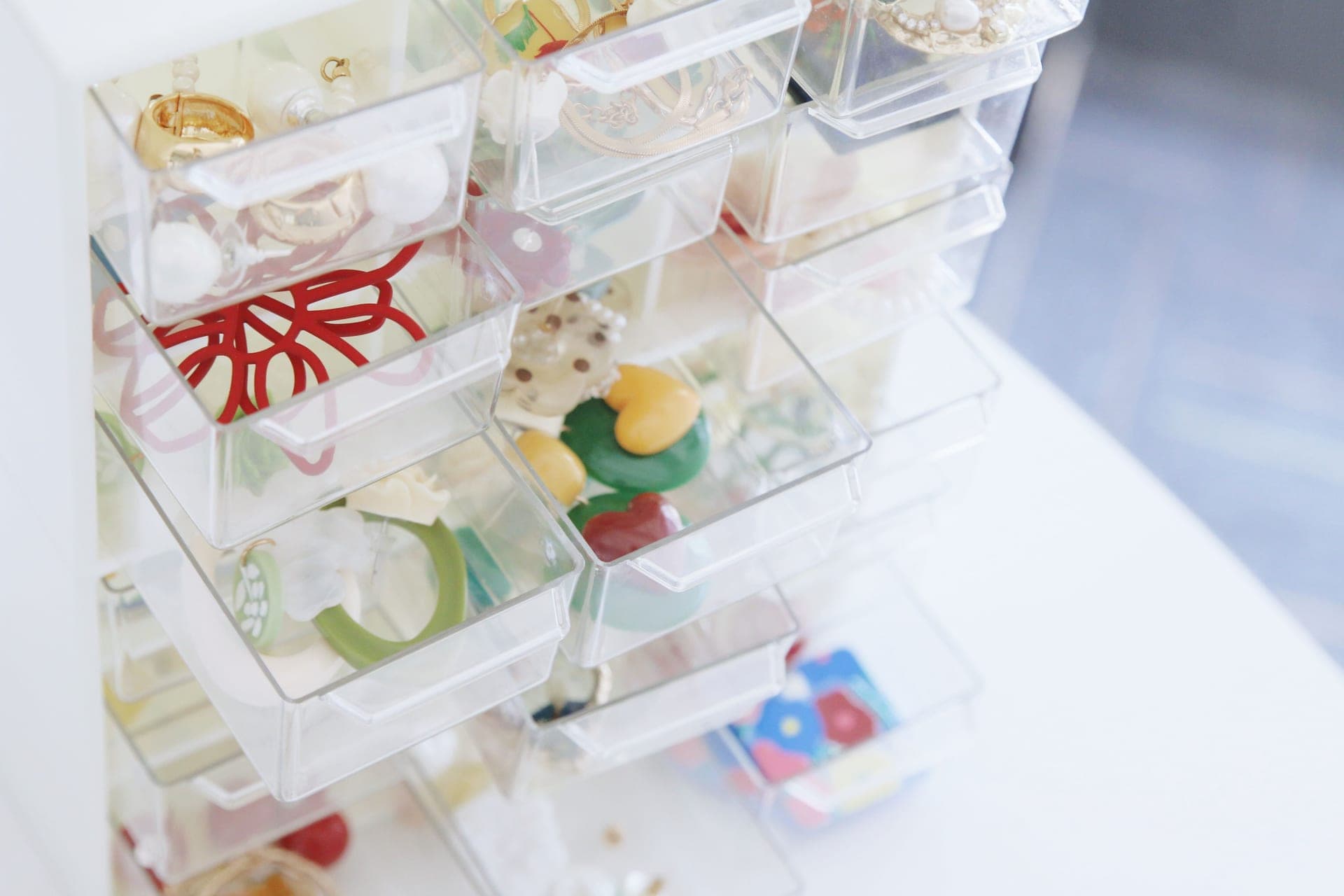
Why storage beats cleaning, permanently
Tarnish on silver is not dirt. It is silver sulfide - a chemical compound formed when the metal reacts with sulfur-bearing compounds in the air. That reaction consumes silver at the surface, and polishing removes the compound along with the silver it was made from.
Which means every polish is a small, permanent subtraction. Do it often enough over decades and detail softens and engraving blurs. Nothing dramatic, but it is a one-way process, and it is entirely avoidable - because the reaction needs air and you can simply not supply any.
That is the whole argument for storage. It is the only part of jewelry care that costs nothing and takes nothing away. Cleaning method matters too, and the safe ones are on how to clean silver jewelry.
What each material actually needs
| Material | What threatens it in storage | Correct storage |
|---|---|---|
| Sterling silver | Airborne sulfur compounds | Closed container, anti-tarnish tab, dry |
| Gold filled | Abrasion from harder pieces | Separate compartment, soft lining |
| Gold plated / vermeil | Abrasion - the coating is microns thick | Its own pouch, never loose with anything |
| Stainless steel | Almost nothing | Anywhere, separated so it scratches nothing else |
| Titanium | Almost nothing | Anywhere; it is harder than most of what it sits with |
| Pearls | Dryness, and abrasion from metal | Soft cloth pouch, some humidity, never sealed plastic |
| Opal and turquoise | Dryness - they contain water | Cloth, away from desiccants and heat |
The two rows that surprise people are the last two. Sealed, desiccated storage is excellent for silver and actively harmful to pearls and opals, which contain water and can craze if they dry out. If you store both, store them separately - this is not a preference, it is two different materials with opposite requirements.
The mistakes that do real damage
- Everything in one dish on a dresser. Maximum air, maximum contact, maximum scratching. It is how most jewelry is stored and it is the worst option available.
- Storing pieces damp. Skin oils plus moisture in a closed box is a faster tarnish environment than an open shelf. Dry first, then close.
- Bathroom storage. Humid, warm, and full of sulfur-bearing products. The worst room in the house for it.
- Coiling chains. A coiled herringbone or snake chain develops kinks that no jeweler can properly remove. Hang or roll them flat - see chain types explained for which styles are vulnerable.
- Rubber bands and newspaper. Both contain sulfur. Both are common improvised storage. Both tarnish silver quickly.
How long anti-tarnish products actually work
Anti-tarnish tabs and treated linings work by absorbing airborne sulfur compounds, and they are genuinely effective. The part almost nobody is told: they saturate. A tab is typically effective for around six months in a closed container, and a treated box lining for roughly 1-3 years, after which it stops working and gives no indication that it has.
So treat tabs as a consumable and replace them on a schedule. A hundred-tab pack is a multi-year supply and costs less than one professional polish.
Travel, which is where pieces actually get damaged
More jewelry is lost and damaged in transit than at home. Three things fix most of it: a roll or case with individual compartments so nothing rattles against anything else, ring rolls so rings cannot escape, and putting the case in hand luggage rather than checked baggage.
A roll format is specifically better than a box for chains, because it lets a necklace lie flat and straight instead of coiled in a corner. For a weekend that is the difference between unpacking a chain and unpacking a knot.
Every pick in detail
What each one is actually made of, how long it realistically lasts in that material, who it is for and who should skip it.
1 · Best anti-tarnish buy
Rosenthal Collection Anti-Tarnish Strips, 100 Tabs
The most effective thing on this page, because it prevents tarnish instead of removing it - and every removal costs you silver.
- What it is
- Anti-tarnish tabs, 1x1in, 100 pieces. They work by absorbing the airborne sulfur compounds that cause silver tarnish, in a sealed space.
- Realistic lifespan
- Each tab is typically effective for around six months in a closed container, then saturates. The 100-pack is a multi-year supply.
- 100 tabs
- 1x1in
- ~6 month life each
What works
- Prevention beats polish: every polish removes silver permanently, a strip removes nothing
- A hundred tabs covers a whole box for years at a few cents each
- Works in any sealed container - a box, a bag, a drawer
What does not
- Only works in a CLOSED space; a tab in an open tray does nothing
- They expire silently - mark the date you put them in
Skip it if: you own no sterling. Gold, steel and titanium do not tarnish, and these strips do nothing for them.
#ad how we make money · price as of September 18, 2026
Best for anyone who owns sterling and is tired of polishing it. Score 8.6/10 from published specifications.
2 · Best box for silver
StarCrafts Vintage Jewelry Box with Anti-Tarnish Lining
The only box here that addresses tarnish rather than just storing things. The catch is that the treatment expires silently.
- What it is
- Lacquer-finished jewelry box with an anti-tarnish lining. Anti-tarnish linings work by absorbing airborne sulfur compounds - the actual cause of silver tarnish.
- Realistic lifespan
- The box is permanent. The anti-tarnish property is NOT: treated linings become saturated and stop working, typically within 1-3 years, and nobody tells you when.
- anti-tarnish lining
- lacquer finish
- treated fabric
What works
- Anti-tarnish linings genuinely slow silver tarnish - this is chemistry, not marketing
- Attacks the cause rather than treating the symptom with polish
What does not
- The lining saturates and stops working with no visible sign - budget for anti-tarnish strips as a top-up
- Expensive for the size
Skip it if: you own no silver. Gold, steel and titanium do not tarnish, so the whole feature is wasted on them.
#ad how we make money · price as of September 18, 2026
Best for a sterling silver collection you are tired of polishing. Score 7.4/10 from published specifications.
3 · Best modular storage
Elsjoy Velvet Stackable Jewelry Trays, 8 Pack
Modular storage that grows with the collection instead of being outgrown by it. The velvet lining is the part that matters.
- What it is
- Velvet-lined stackable trays. Velvet is the correct lining - soft enough not to abrade silver, and it does not shed the way felt does.
- Realistic lifespan
- Trays have nothing to break. Velvet compresses over years but does not fail.
- 8 trays
- velvet lined
- stackable
What works
- Velvet lining is genuinely gentler on soft metals than the plastic in cheaper organizers
- Modular - add trays rather than replacing the whole box
- Fits inside an existing drawer, which uses space you already have
What does not
- No lid, so open trays collect dust
- Stacked trays mean unstacking to reach the bottom one
Skip it if: you want dust protection. Open trays are for a drawer; a closed box is for a surface.
#ad how we make money · price as of September 18, 2026
Best for a growing collection, or fitting storage to an existing drawer. Score 8.1/10 from published specifications.
4 · Best for travel
BELALIFE Travel Jewelry Organizer Roll
The right travel format for chains specifically: a roll keeps a necklace laid flat rather than coiled, which is what protects strands and herringbone.
- What it is
- Roll-up travel organizer with separate compartments and ring rolls.
- Realistic lifespan
- The tie or zip fails first, typically after several years of travel.
- roll format
- ring rolls
- compartments
What works
- A roll lets a chain lie flat - the only travel format that does
- Correct choice for pearl strands and herringbone, which coiling damages
- Packs into a bag corner
What does not
- Lower capacity than a hard case
- Soft-sided; it will not protect against crushing
Skip it if: you travel with rings and studs only. A hard mini case protects small items better and costs less.
#ad how we make money · price as of September 18, 2026
Best for traveling with chains, strands or anything that kinks. Score 7.4/10 from published specifications.
Common questions
How do you store silver jewelry so it does not tarnish?
Dry it, put each piece in its own closed container or zip bag, and add an anti-tarnish tab. Keep it out of the bathroom. That combination stops almost all tarnish, and it costs a few cents per piece per year.
Should jewelry be stored in the bathroom?
No. It is the warmest, most humid room in the house and it is full of sulfur-bearing products. A bedroom drawer is better in every respect, and a drawer is also dark, which helps anything with an organic or dyed component.
How often do anti-tarnish strips need replacing?
Roughly every six months in a closed container. They saturate silently - there is no visual indication that a tab has stopped working, which is why replacing them on a schedule rather than on appearance is the only reliable approach.
Can I store all my jewelry together?
Not without cost. Harder pieces scratch softer ones, which matters most for plated and vermeil items where the coating is only microns thick. Separate compartments are the single highest-value thing in any storage product.
Sources
Every specification and figure on this page traces to one of these. Where a source does not publish a number, the page says so rather than estimating one.
- 16 CFR 23.5 - Misrepresentation as to silver content — 'Sterling' requires at least 925/1000ths pure silver; 'coin silver' at least 900/1000ths.
- 16 CFR 23.11 - Misuse of 'corrosion proof', 'rust resistant', etc. — Governs the durability claims routinely made in jewelry listings.
- 16 CFR Part 23 - Guides for the Jewelry, Precious Metals, and Pewter Industries — The full FTC Jewelry Guides, which govern every material claim quoted on this site.
- 16 CFR 23.23 - Disclosure of treatments to pearls and cultured pearls
Read next
- Best jewelry boxes
The storage products themselves, ranked on lining and separation.
- How to clean silver jewelry
For the tarnish that got there before you started storing it properly.
- Best jewelry organizers
Hanging, drawer and wall options for collections that outgrew a box.
- Can you shower with jewelry?
The other half of keeping a piece intact: what you wear it through.