Metals
Gold Dipped vs Gold Plated
One of these words is defined in federal regulation. The other is a word a seller chose - and that difference is the whole comparison.
#ad — we earn a commission on qualifying Amazon purchases at no extra cost to you. How this site is funded. Prices are live and shown as of October 23, 2026.
The short answer
“Gold plated” is defined by federal regulation: the gold layer must be at least 0.175 microns thick. “Gold dipped” is defined by nobody. It usually describes a very thin coating - often thinner than the plating minimum - and it typically wears through in months rather than years.
What to buy
| # | Pick | Material | Score | Price |
|---|---|---|---|---|
| 1 |  Kooljewelry 14k Gold Filled Cable Chain Necklace Gold-filled in the listing's own words - the tier where the gold is measured by weight, not by guess Top pick | 14K gold-filled (1.5mm cable, 18in). Gold-filled means a bonded gold layer that is at least 5% of the item's total weight - a legal definition under the FTC jewelry guides, not a marketing phrase.Best lasting choice | 8.8/10 | |
| 2 | 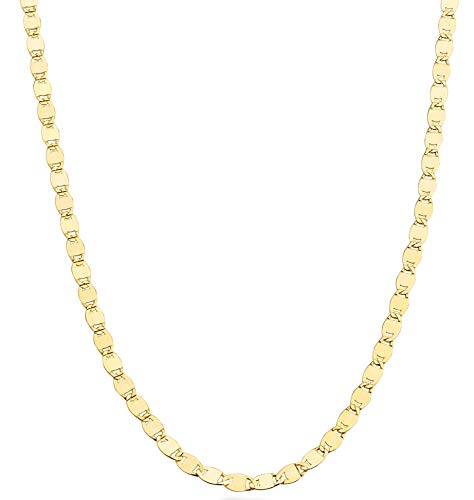 Miabella Italian 925 Sterling Silver, 18Kt Gold Plated Mirror Link Necklace Sterling base and a stated gold plating - the middle tier, with a silver core worth something underneath | 18Kt gold plated over 925 sterling silver, made in Italy. Gold over sterling is the vermeil construction, but the listing does not publish a plating thickness - and US vermeil requires at least 2.5 microns. Without the number we call this gold-plated sterling, not vermeil.Best middle tier | 7.1/10 | $27.90 - View on Amazon $29.90 7% off |
| 3 |  14K Gold Plated 316L Stainless Steel Herringbone Necklace Gold coating over steel: honest about being a coating, and the substrate cannot corrode under it | 14K gold plated over 316L stainless steel. Plated - but over marine-grade steel, so when the gold thins the metal underneath is corrosion-proof rather than corrodible.Best cheap coating | 7.5/10 | $9.98 - View on Amazon $12.99 23% off |
| 4 |  Jewlpire 18k Gold Plated Cable Chain Necklace, 1.1mm An unambiguous plated chain at a plated price - what 'dipped' listings are usually selling, labeled correctly | 18K gold PLATED - the 18K describes the coating, not the chain. The listing does not name the base metal or the plating thickness.Best honest budget pick | 6.2/10 |
Only one of these words is defined
The FTC Jewelry Guides at 16 CFR 23.3 set out what a seller may call gold and when. The relevant thresholds are specific numbers:
- Gold electroplate / gold plated: a minimum thickness throughout equivalent to 0.175 microns of fine gold.
- Heavy gold electroplate: a minimum thickness throughout of 2.5 microns.
- Gold filled / rolled gold plate: the bonded gold must constitute at least 1/20th of the weight of the metal in the entire article.
The word “dipped” does not appear in that regulation. Not as a defined tier, not as a permitted marking, not as a prohibited one. It is a word sellers use, and because it is undefined it carries no obligation - a listing saying “18K gold dipped” has committed to nothing about how much gold is on the item.
The guides do recognize the idea of a coating too thin to qualify: they contemplate an item “covered with a thin wash of gold” and require disclosure in that situation. That is the tier “dipped” usually lives in - gold flash, gold wash, a coating measured in hundredths of a micron rather than tenths.
The tiers, with the numbers attached
| Term | Defined? | Gold layer | Realistic life (daily wear) |
|---|---|---|---|
| Solid gold (10K-18K) | Yes - by karat | All the way through | Generations |
| Gold filled | Yes - 1/20th by weight | Bonded, very thick | 10-30 years |
| Vermeil | Yes - 2.5 microns on sterling | 2.5+ microns | 3-10 years |
| Heavy gold electroplate | Yes - 2.5 microns | 2.5+ microns | 3-10 years |
| Gold plated | Yes - 0.175 microns | 0.175+ microns | 6 months - 3 years |
| Gold dipped | No | Unstated, usually very thin | Weeks to months |
| Gold flashed / gold washed | Thin-wash disclosure applies | Under 0.175 microns | Weeks to months |
| '18K gold' on a cheap heavy chain | No - describes the coating | Unstated | Unknowable |
Read down that table and the pattern is clear: the terms that mean something are the terms with a number behind them. Every rung where the seller got to choose the vocabulary is a rung where you cannot predict the outcome. The three defined tiers are compared directly in gold types explained.
How long does gold dipped jewelry actually last?
Honestly: we cannot give you a number, and anyone who gives you one is guessing. The lifespan of a coating is a function of its thickness, and “dipped” does not state a thickness. That is not evasion - it is the single most useful thing to understand about the word.
What can be said is the bracket. If a dipped coating were as thick as the plating minimum, the seller would have every commercial reason to say “gold plated” instead, because plated is the better-understood and better-selling word. A seller choosing “dipped” over “plated” is usually telling you something by omission. Expect flash-plating behavior: visible wear at the highest-friction points first - the back of a ring, the inside of a bangle, the clasp area of a chain - inside weeks to a few months of daily wear.
Two things accelerate it regardless of tier. Sweat is mildly acidic and attacks the base metal through any pinhole in the coating. Anything that abrades - a gym, a steering wheel, a keyboard, a seatbelt - removes the coating mechanically. The full wear model, with the variables separated out, is on how long does gold plating last.
The phrases that behave like ‘dipped’
“Dipped” does not travel alone. Four more phrases do much the same job, and it is worth being able to sort them by whether a number is attached.
- “Gold tone” / “gold color”: the most honest of the group, oddly enough. It is not claiming to contain gold at all - it is describing a color. Usually brass, or steel with a coating. Priced accordingly, it is not a trick.
- “18K gold finish” / “18KGP”: a coating of unstated thickness. The GP is gold plated, so the 0.175-micron floor should apply, but the karat number is describing the film rather than the object it sits on.
- “Gold overlay” / “rolled gold plate”: these two genuinely are defined, and they sit just below gold-filled. The regulation requires the plating to be at least 1/40th of the weight of the metal in the whole article, at not less than 10 karat fineness - and it requires that fraction to be printed immediately before the karat mark, as in “1/40th 12 Kt. Rolled Gold Plate.” A listing using the phrase without the fraction has an incomplete marking.
- “Gold bonded”: no defined meaning. It borrows the word bonded from the gold-filled process without committing to the weight threshold that is what makes gold-filled mean anything.
The sorting rule is the same every time: a number or a fraction makes a phrase checkable, and an adjective does not. Gold-filled, 1/40th rolled gold plate, 2.5-micron vermeil and 0.175-micron plating are claims you could hold a seller to. Dipped, bonded, tone and finish are descriptions of intent.
What is underneath matters as much as what is on top
A coating is only half the item. The base metal under it decides what happens once the coating is breached - and on a dipped piece it will be breached.
- Over brass or copper alloy: the commonest budget base, and the one that turns skin green. Brass is copper plus zinc, and the copper is the part that reacts with sweat. Once the gold is gone you are wearing brass. See what is brass jewelry.
- Over sterling silver: the vermeil construction. When the gold wears you are wearing a sterling piece, which is a perfectly good piece. This is why vermeil is worth more than its coating thickness alone suggests - what is gold vermeil has the legal definition.
- Over stainless steel: increasingly common, usually with a PVD coating rather than electroplating. Steel does not corrode and does not react with most skin, so the failure mode is cosmetic only. Compared directly in gold filled vs PVD.
- Over unspecified “alloy”: the listing is telling you it will not tell you. The FTC guides cover precious metals and their imitations; a base metal sitting under a coating is not itself an industry product requiring disclosure, which is precisely how a listing can stay silent about it.
Is 'dipped' ever a legitimate description?
Occasionally, and worth saying so. Two cases:
Literal dipped objects. Real roses, leaves and baby shoes dipped in metal as keepsakes. Here “dipped” is a plain description of the process, nobody is implying a jewelry-grade construction, and the item is bought as an object rather than as gold.
Casual usage for genuine plating. Some small makers say “gold dipped” meaning “gold plated” because it sounds friendlier, and their plating is real. You can usually tell: if the same listing states a micron figure, names the base metal, or uses the word vermeil anywhere, the vocabulary is loose rather than evasive. If the listing says “dipped” and nothing else - no base metal, no thickness, no karat - take the word at face value.
The one check that cuts through all of it
Gold is benchmarked twice a day by weight on an open market. That makes weight-against- price the most reliable test available to a buyer who cannot see the item.
A heavy, wide, substantial-looking gold chain contains a large amount of metal. If it is solid gold, the metal alone costs hundreds or thousands of dollars and no seller will discount it, because the metal is the floor. So when a wide heavy chain is inexpensive, the gold is a coating and the karat number in the title is describing the coating, not the chain. This holds whatever word the listing uses - dipped, plated, filled, or just “18K.”
The corollary is more useful than the warning: at a given price, the honest listing is usually the better buy. A chain labeled “gold plated brass” at $20 and one labeled “18K gold dipped” at $20 are probably the same construction, and the first seller is the one telling you. Buy from the listing that names its material. The rest of the pattern-recognition is in how to read a jewelry listing.
What to buy instead, by what you actually want
If you want it to last: gold-filled. The 1/20th-by-weight threshold means the gold is measured rather than estimated, and ten to thirty years of color is the normal outcome. It costs roughly double a plated equivalent and that is the entire trade.
If you want a sterling core: vermeil. The 2.5-micron minimum over a sterling base means that when the gold does wear, the piece underneath still has value.
If you want cheap and you know it is cheap: buy plated, labeled plated, and buy it on purpose. A $15 plated chain worn for a season is a rational purchase and this site will not pretend otherwise. What is not rational is paying a vermeil price for a dipped coating because the listing used an undefined word.
If you want zero maintenance: skip coatings entirely. Solid sterling, stainless steel and titanium have nothing on the surface to lose. The tarnish-resistant picks under $100 are all built that way, and G23 titanium is the extreme version of the idea.
Every pick in detail
What each one is actually made of, how long it realistically lasts in that material, who it is for and who should skip it.
1 · Best lasting choice
Kooljewelry 14k Gold Filled Cable Chain Necklace
The clearest gold-filled starter chain in the set - the listing says gold-filled in those words, which is most of what you are paying for.
- What it is
- 14K gold-filled (1.5mm cable, 18in). Gold-filled means a bonded gold layer that is at least 5% of the item's total weight - a legal definition under the FTC jewelry guides, not a marketing phrase.
- Realistic lifespan
- Gold-filled worn daily typically holds its color 10-30 years. Assumes daily wear, removal for swimming, and no repeated chemical contact.
- 1.5mm cable
- 14K gold-filled
- 18in
What works
- Unambiguous gold-filled labeling - the material claim is checkable
- Cable link is the most repairable chain style if a link ever opens
- Gold-filled tolerates sweat and daily wear in a way plating does not
What does not
- Costs roughly twice a plated chain of the same look
- 1.5mm is dainty; it will not read as a statement chain
Skip it if: you change chains with the season. For a one-season trend piece a $12 plated chain is the rational purchase and we would not talk you out of it.
#ad how we make money · price as of October 23, 2026
Best for a first chain you want to still own in ten years. Score 8.8/10 from published specifications.
2 · Best middle tier
Miabella Italian 925 Sterling Silver, 18Kt Gold Plated Mirror Link Necklace
Gold over real sterling from an established Italian maker. The base metal is honest even though the plating spec is not published.
- What it is
- 18Kt gold plated over 925 sterling silver, made in Italy. Gold over sterling is the vermeil construction, but the listing does not publish a plating thickness - and US vermeil requires at least 2.5 microns. Without the number we call this gold-plated sterling, not vermeil.
- Realistic lifespan
- If it clears 2.5 microns, 1-3 years of daily wear before visible thinning at friction points. If the plating is thinner, months. The listing does not let us tell you which - but the sterling underneath is worth keeping either way.
- 18Kt plated
- 925 sterling base
- microns not published
What works
- Sterling base, not brass - when the plating wears you own silver, not scrap
- Italian chain manufacture is a genuine quality signal in chain-making
What does not
- No published micron thickness, so 'vermeil' cannot be confirmed
- Plated gold on a chain wears at the back of the neck first, and always will
Skip it if: you want gold that lasts a decade. Gold-filled has roughly ten times the gold and holds its color for ten times as long.
Best for the gold look with a base metal that is still worth something when the gold goes. Score 7.1/10 from published specifications.
3 · Best cheap coating
14K Gold Plated 316L Stainless Steel Herringbone Necklace
The best construction in budget plated jewelry: gold over 316L. Same coating life as plating over brass, far better failure mode.
- What it is
- 14K gold plated over 316L stainless steel. Plated - but over marine-grade steel, so when the gold thins the metal underneath is corrosion-proof rather than corrodible.
- Realistic lifespan
- Gold plating over steel typically 1-3 years of daily wear. Unlike plating over brass, the end state is a steel chain, not a green neck.
- 14K plated
- 316L base
- herringbone
What works
- 316L base is named - most plated jewelry hides its base metal
- When the plating goes you still have a wearable steel chain
- Under $10 for a construction that usually costs three times more
What does not
- Herringbone kinks permanently if twisted, regardless of metal
- Plating over steel still wears in 1-3 years
Skip it if: you want gold color that lasts. Only gold-filled or solid gold does; everything else is a countdown.
Best for a gold-tone chain worn in water, sweat and daily life for under $10. Score 7.5/10 from published specifications.
4 · Best honest budget pick
Jewlpire 18k Gold Plated Cable Chain Necklace, 1.1mm
A $20 plated chain is a fair $20 plated chain. Expect a year, not a decade, and it is a perfectly rational purchase on those terms.
- What it is
- 18K gold PLATED - the 18K describes the coating, not the chain. The listing does not name the base metal or the plating thickness.
- Realistic lifespan
- Typical gold plating on a chain holds 6-18 months of regular wear before thinning at the clasp and the back of the neck. Assumes daily wear, no removal for showering, no perfume contact.
- 1.1mm cable
- 18K plated
- base metal not stated
What works
- Looks correct for the price on day one
- Cheap enough that a year of wear is genuinely good value
What does not
- Base metal is not named - the layer that touches your skin when the gold goes
- The 18K figure describes a coating you cannot measure
Skip it if: this is a gift meant to last, or you are sensitive to base metals. Neither question is answerable from this listing.
#ad how we make money · price as of October 23, 2026
Best for a trend chain for one or two seasons. Score 6.2/10 from published specifications.
Common questions
Is gold dipped the same as gold plated?
Not reliably. “Gold plated” is defined in 16 CFR 23.3 as a layer of at least 0.175 microns. “Gold dipped” has no definition in that regulation, so it can describe a coating thinner than the plating minimum. Some sellers use it loosely for genuine plating; others use it precisely because it commits to nothing.
How long does gold dipped jewelry last?
There is no honest single number, because “dipped” states no thickness. The realistic bracket for a flash-thin coating in daily wear is weeks to a few months before visible wear at friction points. Defined tiers give defined answers: plated is 6 months to 3 years, vermeil 3 to 10, gold-filled 10 to 30.
Can gold dipped jewelry be re-dipped?
A jeweler can re-plate most pieces, and it typically costs more than a cheap dipped chain is worth. It is worth doing on a sterling-based or solid-metal piece you care about, and almost never worth doing on plated brass. Buying one tier up once is cheaper than re-plating twice.
Will gold dipped jewelry turn my skin green?
It depends entirely on the base metal, and a thin coating means you will reach it sooner. Over brass or copper alloy, green skin is likely once the coating is breached. Over sterling or stainless steel it is not. See why jewelry turns skin green.
What should I look for instead of 'gold dipped'?
Look for a word with a threshold attached: gold-filled, vermeil, heavy gold electroplate, or a stated micron figure. Also look for the base metal to be named. A listing that names both its coating spec and its substrate is giving you enough to predict how the piece will behave.
Sources
Every specification and figure on this page traces to one of these. Where a source does not publish a number, the page says so rather than estimating one.
- 16 CFR 23.3 - Misrepresentation as to gold content (FTC Jewelry Guides) — Defines the gold-plate minimum (0.175 microns), heavy gold electroplate (2.5 microns) and the gold-filled 1/20th-by-weight threshold.
- 16 CFR 23.4 - Misuse of the word 'vermeil' — Vermeil requires a sterling silver base, gold of at least 10 karat fineness, and a minimum 2.5 microns throughout.
- 16 CFR Part 23 - Guides for the Jewelry, Precious Metals, and Pewter Industries — The full FTC Jewelry Guides, which govern every material claim quoted on this site.
- 16 CFR 23.0 - Scope and application of the FTC Jewelry Guides — The guides cover precious metals (gold, silver, platinum group), precious metal alloys and their imitations. Base metals under a coating are not themselves an 'industry product' requiring disclosure - which is why a listing can be silent about what the plating sits on.
- LBMA Gold Price - the London benchmark — Gold is benchmarked twice a day in US dollars per troy ounce. Why the metal in a piece is not the part that goes on sale.
Read next
- What is gold plated jewelry?
The regulated tier, and the 0.175-micron threshold behind it.
- How long does gold plating last?
The wear model, with each variable separated out.
- Gold filled vs vermeil vs plated
All three defined tiers, side by side with their thresholds.
- Best gold hoop earrings
The same tiers applied to one piece type, priced live.