Metals
Gold Vermeil vs Gold Plated
Both are gold plating. One has a regulated floor fourteen times thicker and a known metal underneath; the other has neither.
#ad — we earn a commission on qualifying Amazon purchases at no extra cost to you. How this site is funded. Prices are live and shown as of November 8, 2026.
The short answer
Vermeil is gold plating - with three conditions. The FTC permits the word only for gold of at least 10 karat fineness, at least 2.5 microns thick throughout, over a sterling silver base. Plain “gold plated” needs only 0.175 microns, over any metal at all. So vermeil buys you roughly 14x the minimum gold and a base metal you can identify. Buy vermeil over plated when the piece touches skin daily.
What to buy
| # | Pick | Material | Score | Price |
|---|---|---|---|---|
| 1 | 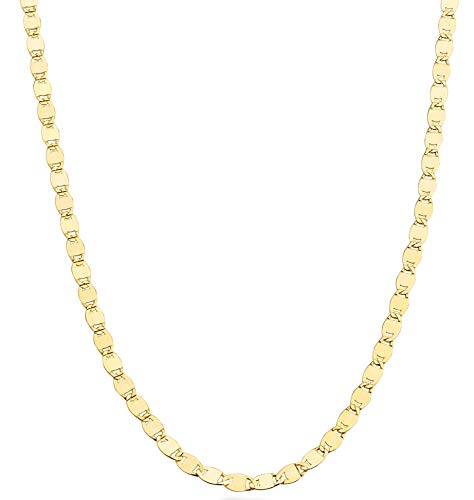 Miabella Italian 925 Sterling Silver, 18Kt Gold Plated Mirror Link Necklace Gold over Italian sterling - the vermeil construction with the base metal named, though the listing publishes no micron figure so the word cannot be confirmed Top pick | 18Kt gold plated over 925 sterling silver, made in Italy. Gold over sterling is the vermeil construction, but the listing does not publish a plating thickness - and US vermeil requires at least 2.5 microns. Without the number we call this gold-plated sterling, not vermeil.Best gold-over-sterling chain | 7.1/10 | $27.90 - View on Amazon $29.90 7% off |
| 2 |  PAVOI 925 Silver Yellow-Gold Plated Hoop Earrings, 20mm The same construction in the one application where thin gold genuinely survives: an earring abrades far less than a chain or a band | Yellow gold plated over 925 silver, 20mm hoops. Gold over sterling again - and again the listing publishes no plating thickness, so this is gold-plated sterling rather than confirmed vermeil.Best gold-over-sterling earrings | 7.6/10 | |
| 3 |  14K Gold Plated 316L Stainless Steel Herringbone Necklace Plated, but over named 316L stainless steel - so when the gold thins, the metal left against your skin is corrosion-proof rather than unknown | 14K gold plated over 316L stainless steel. Plated - but over marine-grade steel, so when the gold thins the metal underneath is corrosion-proof rather than corrodible.Best plated construction | 7.5/10 | |
| 4 |  micuco 18K Gold Plated Chunky Hoop Earrings, 20mm Ordinary gold plating at its most defensible - a low-friction shape where even a thin coating lasts years, bought for the look rather than the material | 18K gold plated, 7.5mm thick on a 20mm outer diameter. Plated - the 18K is the coating. The listing says no lead or nickel but never names the base metal doing the work underneath.Best cheap plated look | 6.5/10 | |
| 5 |  Jewlpire 18k Gold Plated Cable Chain Necklace, 1.1mm The same plating in its worst application, included to show the difference: a chain rubs the back of the neck all day and the base metal is never named | 18K gold PLATED - the 18K describes the coating, not the chain. The listing does not name the base metal or the plating thickness.What to watch for | 6.2/10 | $13.59 - View on Amazon $19.99 32% off |
| 6 |  Kooljewelry 14k Gold Filled Cable Chain Necklace The way out of the argument entirely - gold-filled is 1/20th gold by weight, which is roughly ten times the gold in vermeil and a checkable threshold | 14K gold-filled (1.5mm cable, 18in). Gold-filled means a bonded gold layer that is at least 5% of the item's total weight - a legal definition under the FTC jewelry guides, not a marketing phrase.Best if you want it to last | 8.8/10 |
The short version
These are not two different processes. Vermeil is gold plating. What separates them is a set of conditions the word “vermeil” carries and the phrase “gold plated” does not.
Under 16 CFR 23.4, a product may be described as vermeil only when it has a base of sterling silver, coated on all significant surfaces with gold or a gold alloy of not less than 10 karat fineness, of reasonable durability, at a minimum thickness throughout equivalent to 2.5 microns. All three conditions are required, and the word “throughout” is doing real work - it blocks a thick patch on the front with nothing on the back.
Under 16 CFR 23.3, the floor for calling a surface gold plate is 0.175 microns of gold. That is a few ten-thousandths of a millimeter. The regulation says nothing whatever about what sits underneath it, because base metals under a coating are not themselves the thing the guides regulate - which is precisely why a listing can be completely silent about the metal that will be touching your skin in eighteen months.
So the gap is 2.5 microns against 0.175 microns - about 14x - plus a named base metal against an unnamed one. That is the entire comparison. Everything below is what follows from it.
| Gold vermeil | Gold plated | Gold-filled | |
|---|---|---|---|
| Minimum gold | 2.5 microns throughout | 0.175 microns | 1/20th of total weight (5%) |
| Minimum fineness | 10 karat | No minimum specified | 10 karat |
| Base metal required | Sterling silver | Any metal; need not be named | Usually brass; must be bonded |
| Governing section | 16 CFR 23.4 | 16 CFR 23.3 | 16 CFR 23.3 |
| Typical life, daily wear | 1-3 years of color | 6-18 months on a chain | 10-30 years of color |
| What is left when the gold goes | Sterling silver | Unknown - usually brass | Brass core, still bonded |
The base metal is the part that actually matters
Most comparisons of these two stop at the micron figure. That is the less important half.
Every gold coating ends. The question is not whether it wears through - it will, at the clasp, at the back of the neck, on the high points of a ring - but what you are wearing afterwards. With vermeil, the answer is fixed by the definition: sterling silver. You end up wearing a silver chain, which is a real metal with a 92.5% purity standard behind it, worth keeping, and which can be polished, repaired and even re-plated.
With plain gold plate, the answer is whatever the manufacturer chose, and the listing is usually silent. Most often it is brass - copper plus zinc - and copper is the metal that reacts with sweat and skin to leave a green mark. That is not a defect, it is chemistry: why jewelry turns skin green is a copper story, not a quality story. Sometimes the base is steel, which is a much better outcome, and one of the picks on this page names 316L explicitly for exactly that reason. Sometimes it is a zinc alloy, in which case the piece is essentially disposable.
So the practical hierarchy of failure modes, worst to best: unnamed base metal, named brass, named stainless steel, sterling silver. Vermeil guarantees the top of that list by definition. Plating guarantees nothing. The green-mark mechanism in detail: why jewelry turns skin green, and the base metal itself in what brass jewelry actually is.
The uncomfortable part: almost nobody publishes the micron figure
Here is the thing this site will tell you that a brand page will not. The 2.5-micron condition is only useful if somebody states the number - and on marketplace listings, virtually nobody does.
Both gold-over-sterling pieces on this page are a case in point. One is an Italian-made chain described as 18Kt gold plated over 925 sterling silver; the other is yellow gold plated over 925 silver. Both are plainly the construction vermeil describes - gold over sterling - and neither listing publishes a plating thickness. Which means neither can be confirmed as vermeil, and we do not call them vermeil on this site. We call them gold-plated sterling, which is exactly what the listings claim and no more.
That is not an accusation against either seller. It is a gap in what marketplace listings contain, and it is the reason the word “vermeil” is worth less as a buying signal than its regulation suggests. Plenty of pieces sold as vermeil by direct-to-consumer brands do publish microns, and those claims are checkable. Plenty of pieces that say vermeil in a marketplace title publish nothing at all.
So what can you actually check?
One thing, reliably: the base metal. A listing that says 925, “sterling silver base” or “over sterling silver” is making a specific, checkable claim about the metal under the gold - and that claim is the half of the vermeil definition that determines what you own in two years. A listing that says “18K gold plated” and nothing else is telling you about a coating and refusing to tell you about the piece.
Our working rule, and the one this site applies across the gold hub: read the base metal, not the karat number. The karat figure in a plated listing describes a layer measured in ten-thousandths of a millimeter. “Sterling” or “316L” describes the object. One of those two words is doing something useful.
There is one more mark worth knowing: HGE, heavy gold electroplate, also sits at the 2.5-micron threshold under the same section - the same thickness as vermeil, but over any base metal rather than over sterling. So HGE and vermeil are equally thick and not equally informative. The marks and what each one means: gold-filled markings decoded.
Where each one is the right buy
Neither construction is a scam and neither is a mistake. They are priced differently because they are different amounts of gold over different metals, and the right choice depends almost entirely on what the piece is and how it is worn.
| Piece | How hard it abrades | What to buy |
|---|---|---|
| Earrings (studs, huggies, hoops) | Lowest - almost no sliding contact | Plated is genuinely fine here |
| Pendant on a chain | Low for the pendant, high for the chain | Either; the chain fails first |
| Everyday chain | High - the nape of the neck all day | Gold-over-sterling or gold-filled |
| Bracelet | Highest after a ring - desks, sleeves, cuffs | Gold-filled |
| Ring | Worst in jewelry - clamped on a moving joint | Neither. Solid metal only |
Two rows in that table are the whole practical answer. On earrings, plating is a rational purchase - an earring barely slides against anything, so even the thin end of the plating range survives for years, and the cheaper plated hoops on this page are a perfectly sensible buy on those terms. On a ring, no coating works at all; the band is in constant sliding contact with the fingers either side of it, and the high points go back to base metal in months rather than years. The ring shapes that are solid metal instead are in best sterling silver rings and best eternity bands.
What the price difference should look like
Gold-over-sterling costs more than ordinary plating for two reasons that have nothing to do with branding: there is more gold in it, and the thing underneath the gold is silver, which has a commodity price. A plated chain of the same look can be made for a fraction of that because brass costs almost nothing and the coating is measured in ten-thousandths of a millimeter.
In practice that puts a plated chain in the low-to-mid teens, a gold-over-sterling chain at roughly two to three times that, and a gold-filled chain higher again - with a lifespan that is roughly an order of magnitude longer than either. Prices move, so the table at the top of this page carries live figures rather than numbers typed into a paragraph. The one price that should make you suspicious is a “vermeil” piece cheaper than a plain sterling piece of the same size, because that is arithmetic that does not work.
The third option neither word mentions
If what you want is gold color that lasts, the honest answer is that this comparison is the wrong one to be having. Gold-filled requires the gold to be at least 1/20th - 5% - of the weight of the metal in the whole article, bonded rather than deposited. That is a threshold measured in weight rather than in microns, it works out to roughly ten times the gold in a vermeil piece, and it is why gold-filled chains hold their color for a decade or more where plated chains hold it for a year.
The trade is real: gold-filled is only made in a limited range of styles, it costs more, and it is brass under the gold rather than silver - so the failure mode at the very end of its life is worse than vermeil's. But the end of its life is decades away rather than seasons. The tiers side by side: gold filled vs vermeil, gold filled vs gold plated, and the whole ladder in gold types explained.
Care, which differs more than you would expect
Both constructions are a thin gold layer and both are destroyed by the same things: polishing compounds, silver dips, ultrasonic cleaners and stiff brushes all remove gold measured in microns, immediately and permanently. Warm water, a drop of dish soap and a soft cloth is the entire method for either.
The difference comes later. When a vermeil piece wears through, you have a tarnished sterling piece - and sterling tarnish polishes off, so the piece becomes a silver piece rather than a ruined one. When ordinary plating wears through, you have an unnamed base metal that will keep oxidizing and may mark skin, and polishing it does not help because there is nothing underneath worth revealing. Vermeil can also be re-plated economically, because a jeweler is plating onto silver; re-plating brass is rarely worth the labor. The routine for both: how to clean gold-plated jewelry.
What we would actually buy
For an everyday chain you want to still own in five years: neither of these. Buy gold-filled, and accept the narrower style range. For an everyday chain at gold-over-sterling money, the Italian-made plated-sterling chain here is the better construction of the two chains on this page by some distance, because the base metal is named and it is silver.
For earrings, buy plated and do not feel bad about it - the application is gentle enough that the difference between 0.175 and 2.5 microns plays out over years rather than months, and the cheaper hoops here will outlast their own fashion cycle. For a gold-tone piece worn in water, sweat and the gym, the plated-over-316L chain is the best failure mode in budget plating: when the gold thins you still own a corrosion-proof steel chain. And for a ring, do not buy a coating in any form.
If the piece is a gift and you want the material claim to be checkable rather than flattering, the tarnish-resistant options are collected in tarnish-resistant jewelry under $100, and the listing red flags that should stop a purchase are in Amazon jewelry red flags.
Every pick in detail
What each one is actually made of, how long it realistically lasts in that material, who it is for and who should skip it.
1 · Best gold-over-sterling chain
Miabella Italian 925 Sterling Silver, 18Kt Gold Plated Mirror Link Necklace
Gold over real sterling from an established Italian maker. The base metal is honest even though the plating spec is not published.
- What it is
- 18Kt gold plated over 925 sterling silver, made in Italy. Gold over sterling is the vermeil construction, but the listing does not publish a plating thickness - and US vermeil requires at least 2.5 microns. Without the number we call this gold-plated sterling, not vermeil.
- Realistic lifespan
- If it clears 2.5 microns, 1-3 years of daily wear before visible thinning at friction points. If the plating is thinner, months. The listing does not let us tell you which - but the sterling underneath is worth keeping either way.
- 18Kt plated
- 925 sterling base
- microns not published
What works
- Sterling base, not brass - when the plating wears you own silver, not scrap
- Italian chain manufacture is a genuine quality signal in chain-making
What does not
- No published micron thickness, so 'vermeil' cannot be confirmed
- Plated gold on a chain wears at the back of the neck first, and always will
Skip it if: you want gold that lasts a decade. Gold-filled has roughly ten times the gold and holds its color for ten times as long.
Best for the gold look with a base metal that is still worth something when the gold goes. Score 7.1/10 from published specifications.
2 · Best gold-over-sterling earrings
PAVOI 925 Silver Yellow-Gold Plated Hoop Earrings, 20mm
The best case for plated gold: a low-friction application on a sterling base, at $17. Plating on earrings is a much better bet than plating on a bracelet.
- What it is
- Yellow gold plated over 925 silver, 20mm hoops. Gold over sterling again - and again the listing publishes no plating thickness, so this is gold-plated sterling rather than confirmed vermeil.
- Realistic lifespan
- 1-3 years of regular wear for the plating before the sterling shows at the hinge. Earrings wear far slower than chains, so plated earrings genuinely last longer than plated necklaces.
- 20mm
- gold plated
- 925 silver base
What works
- Earrings are the low-wear application where plating actually survives
- Sterling base means no green ears when the gold thins
- 20mm is a visible hoop, unlike most budget huggies
What does not
- No published micron figure
- Gold plating over silver eventually shows a cool line where it has worn
Skip it if: you shower and swim in your earrings. Gold-filled hoops cost about the same and take that abuse far better.
#ad how we make money · price as of November 8, 2026
Best for gold-toned hoops you will wear a few times a week. Score 7.6/10 from published specifications.
3 · Best plated construction
14K Gold Plated 316L Stainless Steel Herringbone Necklace
The best construction in budget plated jewelry: gold over 316L. Same coating life as plating over brass, far better failure mode.
- What it is
- 14K gold plated over 316L stainless steel. Plated - but over marine-grade steel, so when the gold thins the metal underneath is corrosion-proof rather than corrodible.
- Realistic lifespan
- Gold plating over steel typically 1-3 years of daily wear. Unlike plating over brass, the end state is a steel chain, not a green neck.
- 14K plated
- 316L base
- herringbone
What works
- 316L base is named - most plated jewelry hides its base metal
- When the plating goes you still have a wearable steel chain
- Under $10 for a construction that usually costs three times more
What does not
- Herringbone kinks permanently if twisted, regardless of metal
- Plating over steel still wears in 1-3 years
Skip it if: you want gold color that lasts. Only gold-filled or solid gold does; everything else is a countdown.
#ad how we make money · price as of November 8, 2026
Best for a gold-tone chain worn in water, sweat and daily life for under $10. Score 7.5/10 from published specifications.
4 · Best cheap plated look
micuco 18K Gold Plated Chunky Hoop Earrings, 20mm
Chunky gold-look hoops for under $15. The look is the product and the look is good; just do not expect them in five years.
- What it is
- 18K gold plated, 7.5mm thick on a 20mm outer diameter. Plated - the 18K is the coating. The listing says no lead or nickel but never names the base metal doing the work underneath.
- Realistic lifespan
- 1-3 years for the plating on an earring, which is the gentlest application plating gets. On a top-clasp hoop the coating goes first at the clasp, not on the face you look at.
- 20mm outer
- 7.5mm thick
- 18K plated
What works
- 7.5mm of thickness on a 20mm hoop reads as a far more expensive earring
- Light for its size, so a thick hoop is not dragging on the lobe all day
What does not
- Nickel-free is claimed but the base metal is never named, so the claim cannot be checked
- 20mm is a small hoop - the chunk here is thickness, not diameter
Skip it if: you want the same hoops in three years, or you want a statement-diameter hoop. This is a thick 20mm, and nothing plated survives daily handling that long.
#ad how we make money · price as of November 8, 2026
Best for the thick-hoop look without spending thick-hoop money. Score 6.5/10 from published specifications.
5 · What to watch for
Jewlpire 18k Gold Plated Cable Chain Necklace, 1.1mm
A $20 plated chain is a fair $20 plated chain. Expect a year, not a decade, and it is a perfectly rational purchase on those terms.
- What it is
- 18K gold PLATED - the 18K describes the coating, not the chain. The listing does not name the base metal or the plating thickness.
- Realistic lifespan
- Typical gold plating on a chain holds 6-18 months of regular wear before thinning at the clasp and the back of the neck. Assumes daily wear, no removal for showering, no perfume contact.
- 1.1mm cable
- 18K plated
- base metal not stated
What works
- Looks correct for the price on day one
- Cheap enough that a year of wear is genuinely good value
What does not
- Base metal is not named - the layer that touches your skin when the gold goes
- The 18K figure describes a coating you cannot measure
Skip it if: this is a gift meant to last, or you are sensitive to base metals. Neither question is answerable from this listing.
Best for a trend chain for one or two seasons. Score 6.2/10 from published specifications.
6 · Best if you want it to last
Kooljewelry 14k Gold Filled Cable Chain Necklace
The clearest gold-filled starter chain in the set - the listing says gold-filled in those words, which is most of what you are paying for.
- What it is
- 14K gold-filled (1.5mm cable, 18in). Gold-filled means a bonded gold layer that is at least 5% of the item's total weight - a legal definition under the FTC jewelry guides, not a marketing phrase.
- Realistic lifespan
- Gold-filled worn daily typically holds its color 10-30 years. Assumes daily wear, removal for swimming, and no repeated chemical contact.
- 1.5mm cable
- 14K gold-filled
- 18in
What works
- Unambiguous gold-filled labeling - the material claim is checkable
- Cable link is the most repairable chain style if a link ever opens
- Gold-filled tolerates sweat and daily wear in a way plating does not
What does not
- Costs roughly twice a plated chain of the same look
- 1.5mm is dainty; it will not read as a statement chain
Skip it if: you change chains with the season. For a one-season trend piece a $12 plated chain is the rational purchase and we would not talk you out of it.
#ad how we make money · price as of November 8, 2026
Best for a first chain you want to still own in ten years. Score 8.8/10 from published specifications.
Common questions
Is gold vermeil better than gold plated?
Yes, on both measures that matter. Vermeil requires at least 2.5 microns of at least 10 karat gold - roughly fourteen times the 0.175-micron minimum for plain gold plate - and it requires a sterling silver base, so you know what you are wearing when the gold eventually thins. Plain gold plate specifies neither thickness beyond that floor nor any base metal at all.
Is gold vermeil just gold plating?
Technically yes - vermeil is produced by plating gold onto a sterling silver base. The word is not a different process, it is a regulated subset: gold of at least 10 karat, 2.5 microns thick throughout, over sterling. If any of those three conditions is missing, the piece is gold plated and not vermeil.
How long does gold vermeil last compared to gold plated?
In daily wear, expect roughly one to three years of gold color from a genuine vermeil piece against six to eighteen months from an ordinary plated chain - with earrings lasting far longer than chains in both cases, because an earring barely abrades. Both figures assume no removal for showering and ordinary skin contact. Gold-filled, with about ten times the gold, runs ten to thirty years.
Does gold vermeil tarnish?
The gold layer does not; the sterling underneath does, once the gold has worn through at the friction points. That is the characteristic vermeil failure - a cool gray line appearing at a clasp or a hinge rather than a green mark. It is also the better failure: sterling tarnish polishes off, and the piece becomes a silver piece rather than a dead one.
Can gold vermeil get wet?
Briefly, yes; routinely, no. Water itself is not the problem - chlorine, salt, soap, shampoo and sweat are, and all of them accelerate the loss of a gold layer measured in microns. Treat vermeil and plated gold identically here: take both off for swimming and showering. Only gold-filled and solid gold genuinely tolerate that.
Is vermeil worth the extra money over plated?
On anything that rubs - a chain, a bracelet - yes, because you are buying both more gold and a base metal worth keeping. On earrings, often not: the application is gentle enough that cheap plating lasts years, so the extra money is better spent on gold-filled for a chain instead. On a ring, neither is worth it; buy solid metal.
How can I tell if something is really vermeil?
Look for all three conditions in the listing: a stated sterling or 925 base, a karat figure of 10K or higher, and a plating thickness of 2.5 microns or more. Most marketplace listings publish the first two and omit the third, which means the vermeil claim cannot be confirmed - so judge on the base metal, which is the half you can check and the half that decides what you own in two years.
Sources
Every specification and figure on this page traces to one of these. Where a source does not publish a number, the page says so rather than estimating one.
- 16 CFR 23.3 - Misrepresentation as to gold content (FTC Jewelry Guides) — Defines the gold-plate minimum (0.175 microns), heavy gold electroplate (2.5 microns) and the gold-filled 1/20th-by-weight threshold.
- 16 CFR 23.4 - Misuse of the word 'vermeil' — Vermeil requires a sterling silver base, gold of at least 10 karat fineness, and a minimum 2.5 microns throughout.
- 16 CFR Part 23 - Guides for the Jewelry, Precious Metals, and Pewter Industries — The full FTC Jewelry Guides, which govern every material claim quoted on this site.
- 16 CFR 23.0 - Scope and application of the FTC Jewelry Guides — The guides cover precious metals (gold, silver, platinum group), precious metal alloys and their imitations. Base metals under a coating are not themselves an 'industry product' requiring disclosure - which is why a listing can be silent about what the plating sits on.
- Copper Development Association - alloy C26000 (cartridge brass) — The CDA's own classification of the commonest brass: wrought, family 'Copper-Zinc Alloys (Yellow Brasses)'. Brass is copper plus zinc - the copper is the part that reacts with skin.
- Copper Development Association - alloy C22000, Commercial Bronze 90% — CDA 220, the brass the gold in gold-filled stock is usually bonded to. The CDA lists it as a wrought copper-zinc alloy named Commercial Bronze, 90%.
- AG Metals - Gold-Filled (mill supplier technical page) — States the trade designation in the supplier's own words: '14/20 GF is the designation for 14 karat gold-filled', the 1/20th being the ratio of karat gold to base metal by weight (5%), bonded over a CDA 220 base.
- Amazon Associates Program Operating Agreement — Why every price on this site is pulled live and date-stamped rather than typed in.
Read next
- What is gold vermeil?
The three FTC conditions in full, and why each one is written the way it is.
- Gold filled vs vermeil
The next tier up, and the construction that ends this argument.
- How long gold plating lasts
The lifespans behind the figures quoted on this page, by piece type.
- How to clean gold-plated jewelry
The same routine serves both constructions - and the cleaners that destroy both.