Metals
Is Gold-Filled Jewelry Worth Anything?
Gold-filled contains real, measurable gold. Run the arithmetic on how much, and the answer to the resale question answers itself.
#ad — we earn a commission on qualifying Amazon purchases at no extra cost to you. How this site is funded. Prices are live and shown as of October 23, 2026.
The short answer
Gold-filled jewelry contains real karat gold - at least 1/20th of the item's weight, which works out at roughly 2.9% of a 14K gold-filled piece as pure gold. On a light chain that is a fraction of a gram, so gold-filled has very little scrap value and is not an investment. Its worth is in wear: 10 to 30 years of gold color for a tenth of solid-gold money.
What to buy
| # | Pick | Material | Score | Price |
|---|---|---|---|---|
| 1 |  14k Gold Filled Rope Chain Necklace, 20in The heaviest gold-filled piece here, which is also the one with the most actual gold in it - bought for the weight and the material Top pick | 14K gold-filled rope chain, 20in. Same 5%-by-weight gold-filled standard as the cable chain, in a heavier braided link.Best gold-filled chain to keep | 8.1/10 | |
| 2 |  14k Gold Filled Satellite Ball Station Necklace, 18in Gold-filled in a layering chain, where it rubs against other chains daily and plating would not survive | 14K gold-filled satellite chain (3mm ball stations on an 18in chain).Best for layering | 8.3/10 | |
| 3 |  Kezef 14K Gold Filled Ball Stud Earrings, 6mm The lowest-wear placement in jewelry, so the gold layer here is closest to its best-case lifespan | 14K gold-filled ball studs, 6mm.Best lowest-wear gold-filled | 8.5/10 |
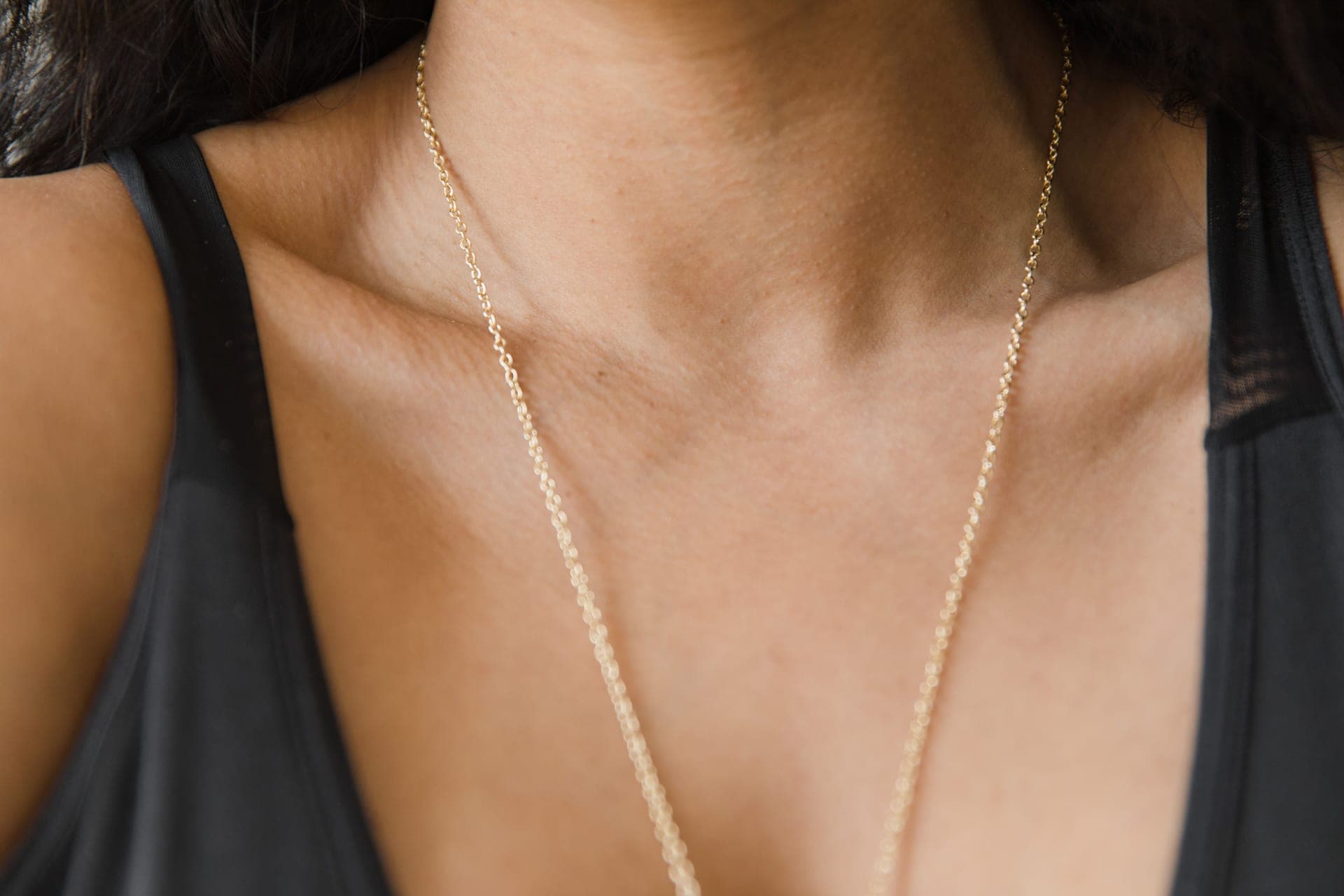
Two different questions hide inside this one
“Is gold-filled worth anything” is asked by two people with opposite problems. One has inherited a box of gold-tone jewelry and wants to know whether to take it to a buyer. The other is standing in front of a listing deciding whether to spend four times the price of a plated chain. The answers point in opposite directions, so it is worth splitting them.
As scrap, gold-filled is worth very little, and this page will show you why with arithmetic rather than opinion. As something to buy and wear, it is one of the best-value materials in jewelry, and it is the material this site recommends more often than any other. Both of those statements are true at once, and the reason is that the gold in gold-filled is real but thin.
The arithmetic, done once
Gold-filled is defined by weight, not thickness. Under the FTC Jewelry Guides a piece may be called gold-filled when the bonded karat gold layer is at least 1/20th - 5% - of the total metal weight. But that 5% is karat gold alloy, not pure gold. 14K is 58.3% gold, so the fine gold content of a 14K gold-filled piece is about 5% of 58.3% - roughly 2.9% of what the piece weighs.
| Item | Typical weight | 14K alloy at 1/20th | Fine gold content |
|---|---|---|---|
| Pair of small studs | ~1 g | ~0.05 g | ~0.03 g |
| Fine cable chain, 18in | ~3 g | ~0.15 g | ~0.09 g |
| Heavier rope chain, 20in | ~10 g | ~0.5 g | ~0.29 g |
| Whole jewelry box of gold-filled | ~100 g | ~5 g | ~2.9 g |
Those are illustrative weights, not measurements of specific products - weigh your own piece if the number matters to you. But the shape of the answer does not change with the input: a normal gold-filled chain holds well under a tenth of a gram of fine gold, and an entire boxful holds a few grams. Compare that with the same chain in solid 14K, where 58.3% of the whole weight is gold rather than 2.9%, and the factor is roughly twenty to one.
Why there is no dollar figure on this page
Two reasons, and both are deliberate. Gold is benchmarked twice a day by the LBMA in US dollars per troy ounce, so any dollar figure written into this page would be wrong within a day - and this site does not publish numbers it cannot keep current. Second, what a buyer actually pays is their own business decision, not a published rate; no source cited on this site publishes refiner or pawnbroker terms, so we will not invent a percentage for you to plan around.
What we can tell you without guessing: the recoverable gold in a gold-filled piece is a fraction of a gram, refining bonded stock is more work than melting solid karat gold, and many buyers decline gold-filled for that reason. If you have a box to clear, weigh it and ask a local buyer what they will do with it. Treat any answer as a small sum, and do not sell a piece you would otherwise wear - as wear, it is worth far more than as metal. The parallel question for plating is answered in is gold-plated worth anything, where the answer is more emphatic: plating at 0.175 microns has effectively no recoverable value at all.
What gold-filled is genuinely worth, then
Worn, it is excellent value, and the case is easy to state. Gold-filled worn daily typically holds its gold color for 10 to 30 years. Gold plate at the FTC minimum of 0.175 microns typically shows base metal in one to three years on the same shape. So for roughly four times the price of a plated chain you get something like ten times the service life, and you get it in a material whose claim is checkable: the words “gold-filled” carry a federal weight threshold, and sellers who meet it advertise it.
You also get a base that behaves well. The core under the gold is normally a copper-zinc alloy - the mill standard is CDA 220 - rather than a nickel-bearing one, which is why gold-filled is markedly less likely to green a neck or irritate skin than plated base metal. It is not a certified nickel-free material and should not be treated as one, but as a practical matter it is the gentlest gold-tone option short of solid karat gold.
Where gold-filled is and is not the right buy
- Best: chains, earrings, pendants. Low-abrasion placements where a bonded layer reaches the top of its lifespan. Both the studs and the layering chain above are there for this reason.
- Good: bracelets. A wrist abrades more than a neck, so expect the shorter end of the range - still many times a plated equivalent.
- Questionable: rings. A ring takes more abrasion than any other piece of jewelry. Solid metal of any karat is the better call, as gold-filled vs solid gold argues.
- Wrong: as a store of value. If the money is meant to hold value, no jewelry is the instrument - and gold-filled least of all, since the gold is a few percent of a light object.
- Wrong: for a diagnosed nickel allergy. Likely fine in practice, but the core composition is not certified. Implant-grade titanium is the zero-question answer - see the hypoallergenic guide.
The short version
Gold-filled contains real gold, in a quantity small enough that its scrap value is negligible and large enough that it behaves like gold for decades. That is not a contradiction - it is the whole design of the material. Buy it to wear, not to hold, and when you do sell or clear a collection, weigh it first and expect a small number. For what the marks on an inherited piece mean, start at gold-filled markings explained; for whether the piece in your hand is gold-filled at all, use the real gold vs plated tests.
Every pick in detail
What each one is actually made of, how long it realistically lasts in that material, who it is for and who should skip it.
1 · Best gold-filled chain to keep
14k Gold Filled Rope Chain Necklace, 20in
A heavy gold-filled rope at a heavy price. Buy it for the weight and the material, not for a bargain.
- What it is
- 14K gold-filled rope chain, 20in. Same 5%-by-weight gold-filled standard as the cable chain, in a heavier braided link.
- Realistic lifespan
- 10-30 years of regular wear for the gold layer. Rope links are the most abrasion-prone style, so friction points at the back of the neck wear first.
- rope link
- 14K gold-filled
- 20in
What works
- Real gold-filled weight - this is the chain plating is imitating
- Rope link hides small scratches better than a flat chain
What does not
- The most expensive chain in this set by a wide margin
- Rope links are difficult to repair cleanly if one goes
Skip it if: your budget is under $100. At that price you are better served by a plain gold-filled cable chain than by stretching for a rope.
#ad how we make money · price as of October 23, 2026
Best for a substantial everyday chain in a material that will outlast plating many times over. Score 8.1/10 from published specifications.
2 · Best for layering
14k Gold Filled Satellite Ball Station Necklace, 18in
The layering chain that is actually gold-filled, at roughly four times the price of the plated ones it sits next to in search results.
- What it is
- 14K gold-filled satellite chain (3mm ball stations on an 18in chain).
- Realistic lifespan
- 10-30 years for the gold layer. The ball stations add surface area but also break up the friction line at the back of the neck.
- 3mm stations
- 14K gold-filled
- 18in
What works
- Layering means chain-on-chain abrasion - the exact case where gold-filled earns its premium
- Unambiguous material labeling
What does not
- Expensive next to the plated satellite chains it competes with visually
- Ball stations can catch on knitwear
Skip it if: you layer one chain at a time. Solo wear is gentle enough that plating survives, and you would be paying for durability you never use.
#ad how we make money · price as of October 23, 2026
Best for the middle chain in a layered stack, where it rubs against the others daily. Score 8.3/10 from published specifications.
3 · Best lowest-wear gold-filled
Kezef 14K Gold Filled Ball Stud Earrings, 6mm
The plainest possible gold-filled stud. Nothing to break, nothing to fall out of style.
- What it is
- 14K gold-filled ball studs, 6mm.
- Realistic lifespan
- 10-30 years for the gold layer. Studs are the lowest-wear jewelry there is.
- 6mm ball
- 14K gold-filled
- post + butterfly back
What works
- Gold-filled, clearly labeled
- 6mm is the size that reads as jewelry without reading as a statement
What does not
- Butterfly backs are the least secure back type - budget for replacements
- Plain ball studs are exactly as plain as they sound
Skip it if: you react to nickel through a gold layer. A brass core can still transmit, though gold-filled is far less likely to than plating.
#ad how we make money · price as of October 23, 2026
Best for a first pair of real-material studs, or a replacement for plated studs that went green. Score 8.5/10 from published specifications.
Common questions
Does gold-filled jewelry have real gold in it?
Yes. Gold-filled is a bonded layer of karat gold that must be at least 1/20th of the item's total weight - about 2.9% of a 14K gold-filled piece as pure gold. It is real gold, mechanically bonded rather than deposited, which is why it lasts so much longer than plating.
Can you sell gold-filled jewelry for scrap?
Some buyers take it and many decline, because the recoverable gold is a fraction of a gram per piece and bonded stock is more work to refine than solid karat gold. Weigh what you have and ask locally - but expect a small sum, and do not sell something you would otherwise wear.
Is gold-filled better than gold-plated?
Substantially. Gold-filled carries a bonded layer at a minimum of 1/20th of the item's weight and typically holds its color for 10 to 30 years. Gold plate can legally be 0.175 microns and typically shows base metal within one to three years on the same shape.
How long does gold-filled jewelry last?
10 to 30 years of gold color in a low-abrasion placement like a chain, pendant or stud, assuming it comes off for swimming and avoids repeated chemical contact. Bracelets and rings sit at the shorter end, because they abrade more.
Is gold-filled jewelry a good investment?
No - and neither is jewelry generally. The gold is a few percent of a light object, and the purchase price also covered manufacturing and margin that no buyer repays. Buy gold-filled for how long it lasts on your neck, not for what it might be worth later.
Sources
Every specification and figure on this page traces to one of these. Where a source does not publish a number, the page says so rather than estimating one.
- 16 CFR 23.3 - Misrepresentation as to gold content (FTC Jewelry Guides) — Defines the gold-plate minimum (0.175 microns), heavy gold electroplate (2.5 microns) and the gold-filled 1/20th-by-weight threshold.
- 16 CFR 23.4 - Misuse of the word 'vermeil' — Vermeil requires a sterling silver base, gold of at least 10 karat fineness, and a minimum 2.5 microns throughout.
- 16 CFR Part 23 - Guides for the Jewelry, Precious Metals, and Pewter Industries — The full FTC Jewelry Guides, which govern every material claim quoted on this site.
- AG Metals - Gold-Filled (mill supplier technical page) — States the trade designation in the supplier's own words: '14/20 GF is the designation for 14 karat gold-filled', the 1/20th being the ratio of karat gold to base metal by weight (5%), bonded over a CDA 220 base.
- Copper Development Association - alloy C22000, Commercial Bronze 90% — CDA 220, the brass the gold in gold-filled stock is usually bonded to. The CDA lists it as a wrought copper-zinc alloy named Commercial Bronze, 90%.
- LBMA Gold Price - the London benchmark — Gold is benchmarked twice a day in US dollars per troy ounce. Why the metal in a piece is not the part that goes on sale.
Read next
- Is gold-plated worth anything?
The same question for a coating, where the answer is blunter.
- Gold-filled vs solid gold
Where the bonded layer wins and where it does not.
- Gold-filled markings explained
What the stamp on an inherited piece is telling you.
- Real gold vs plated tests
How to work out what you are holding before you weigh it.