Care
How to Clean Pearls
Every other material on this site tolerates a soak. Pearls are the one that does not, because a pearl is not a stone.
#ad — we earn a commission on qualifying Amazon purchases at no extra cost to you. How this site is funded. Prices are live and shown as of October 22, 2026.
The short answer
Wipe pearls with a soft damp cloth after every wear and let them air-dry flat. Never soak a strand, never use vinegar, lemon, ammonia, a jewelry dip or an ultrasonic cleaner - nacre is calcium carbonate held in protein, and acids dissolve it while detergents strip its lustre.
What to buy
| # | Pick | Material | Score | Price |
|---|---|---|---|---|
| 1 |  Connoisseurs Extra Large Polishing Cloth, 14x14in A plain soft cloth is the entire recommended toolkit for pearls - use the clean outer layer only, never the compounded side Top pick | Impregnated polishing cloth, 14x14in. Two-layer cloths carry a mild polishing compound in the inner layer and a clean buffing surface outside.Best everyday tool | 8.5/10 | |
| 2 | 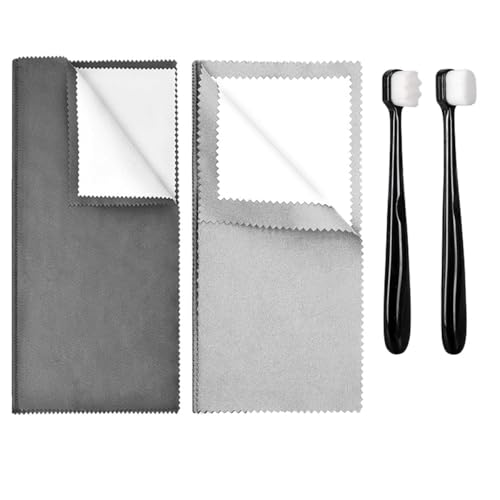 Syyflibb Jewelry Cleaning Cloth and Ultra-Soft Brush Set The ultra-soft brush is the one safe way to reach the drill holes and knots on a strand, where residue actually collects | Polishing cloths plus ultra-soft brushes. Bristle softness is the whole specification: a stiff brush scratches gold, which is soft.Best for a knotted strand | 8.1/10 | |
| 3 |  Elsjoy Velvet Stackable Jewelry Trays, 8 Pack Velvet-lined flat trays - pearls need to lie flat, separately, and away from anything harder than they are | Velvet-lined stackable trays. Velvet is the correct lining - soft enough not to abrade silver, and it does not shed the way felt does.Best storage | 8.1/10 |
Why pearls are the exception on this site
Almost every care page here recommends some version of the same thing: warm water, a drop of mild soap, a soft brush, a rinse, a thorough dry. That method is safe on gold, gold-filled, sterling, steel and titanium. On pearls, most of it is wrong.
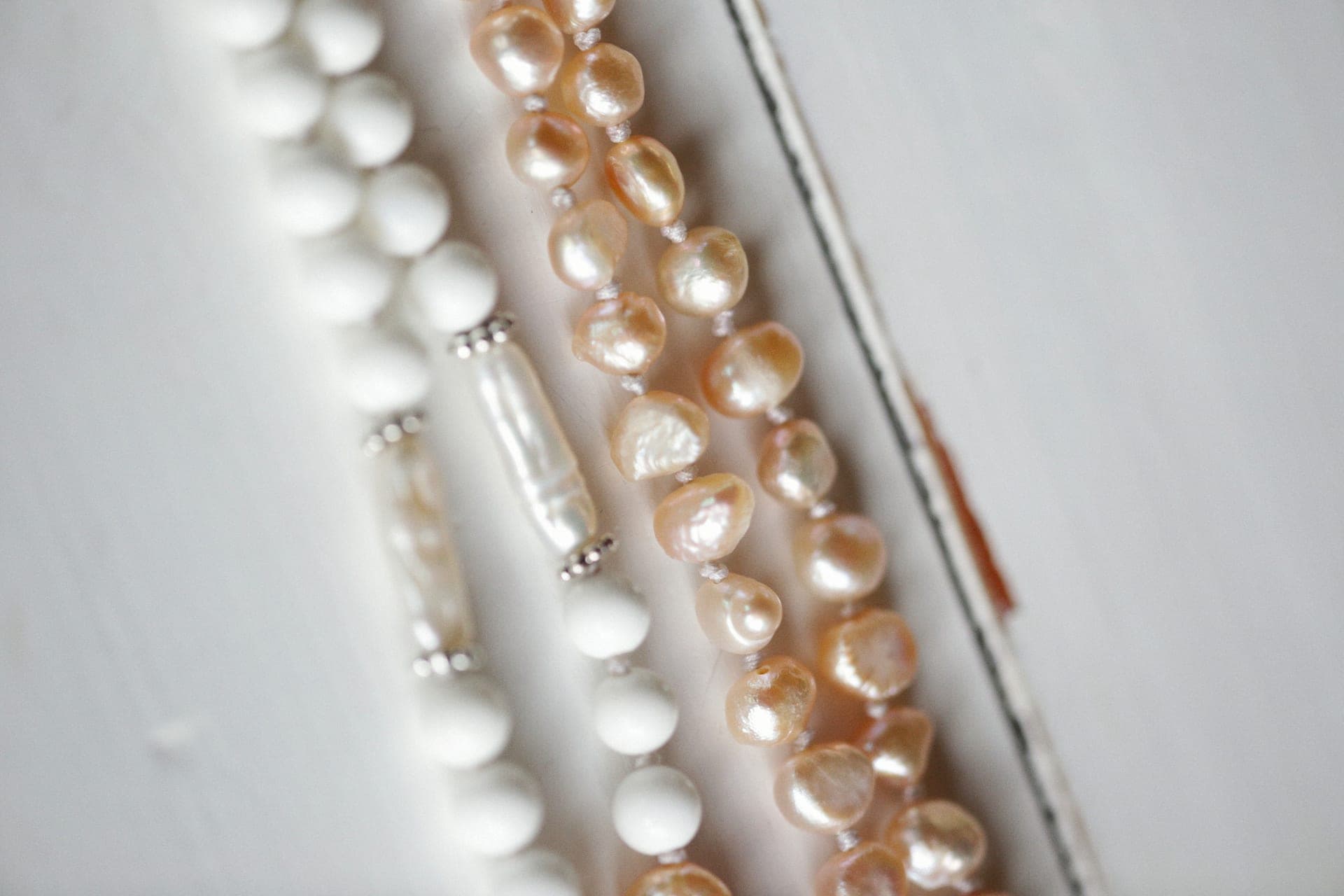
A pearl is not a mineral in the way a sapphire is. It is nacre - microscopic platelets of calcium carbonate, laid down in overlapping layers and bound together by an organic protein called conchiolin. The lustre people pay for is light reflecting off and through those translucent layers. That is an organic, laminated, porous structure, and three things follow:
- Acid dissolves calcium carbonate. Vinegar, lemon juice, descalers and most “natural” cleaning remedies attack nacre directly. The reaction is not subtle and it is not reversible.
- Detergents and solvents attack the protein. Strip the conchiolin binding the platelets and the surface goes chalky, which is exactly the lustre loss you were trying to prevent.
- Nacre is soft. Around 2.5 to 4 on the Mohs scale, against 10 for diamond and 7 for quartz. Dust is largely quartz. A pearl rubbed with a gritty cloth is being sanded.
What a pearl actually is, and the difference between natural, cultured and imitation, is the subject of pearls explained. All five pearl pieces on this site are cultured freshwater pearls - genuine pearls grown in a mollusc, which behave exactly like natural ones for care purposes.
What is safe and what is not
| Method | Safe on pearls? | What happens |
|---|---|---|
| Soft dry cloth after each wear | Yes - the main method | Removes the oils that dull nacre |
| Barely damp cloth, trace of mild soap | Yes, occasionally | Lifts heavier residue safely |
| Ultra-soft brush at the drill holes | Yes, gently | The only way to reach knot residue |
| Soaking or submerging a strand | No | Stretches silk, traps detergent in knots |
| Ultrasonic cleaner | Never | Cavitation separates nacre layers |
| Steam cleaner | Never | Heat and pressure crack nacre |
| Jewelry dip or tarnish remover | Never | Dissolves nacre and strips protein |
| Vinegar, lemon, any acid | Never | Dissolves calcium carbonate |
| Ammonia, bleach, alcohol, acetone | Never | Strips lustre, attacks the binder |
| Toothpaste or baking soda | Never | Abrasive against a Mohs 2.5-4 surface |
| Treated silver polishing cloth | No | The compound in it abrades nacre |
That is an unusually long list of nevers for a material that needs so little. The whole positive instruction is: wipe them, occasionally use a damp cloth, dry them flat.
The habit that matters more than cleaning
“Pearls go on last and come off first” is the oldest piece of jewelry advice there is and it is the single most useful sentence on this page. It matters most on the one day pearls are most likely to be worn - see pearls for weddings and bridesmaid jewelry gifts, both of which run into a room full of hairspray. Perfume, hairspray, hair products, lotion, sunscreen and makeup are all either alcohol-bearing or mildly acidic, and they are the main cause of lustre loss over a lifetime - not a failure to clean, but repeated contact with cosmetics.
The corollary: pearls should be worn, not stored. Nacre contains water within its structure, and skin contact in normal humidity keeps it in reasonable condition. A strand left in a sealed box or a bank vault for twenty years can dry out and craze. That is one of very few cases in jewelry where using something is better for it than protecting it.
Knotted strands: the part people get wrong
A good pearl necklace is strung on silk with a knot between each pearl, which stops the pearls abrading each other and means a broken thread loses one pearl rather than all of them. Silk is also the reason a strand must never be soaked: wet silk stretches, and it holds whatever it absorbed inside the knots, next to the nacre, for days.
- Wipe pearl by pearl rather than running the whole strand through a damp cloth.
- Dry flat on a towel, never hanging - wet silk stretches under the weight.
- If the thread between pearls looks gray, frayed, or if the pearls have visibly spread apart, it needs restringing. That is a jeweler's job and an inexpensive one.
- Restringing is the normal maintenance schedule for a frequently worn strand - roughly every couple of years of regular wear, more often if it is worn against skin in heat.
Pearls set in metal
A pearl stud, pendant or drop is easier than a strand because there is no silk involved - but it introduces a different conflict: the metal may want a cleaning method the pearl cannot survive. A pearl on a sterling setting that has tarnished is the awkward case, because every silver tarnish remedy on how to clean silver jewelry is unsafe for the pearl next to it.
The method is to treat them as two materials. Work polish onto the metal with a cotton bud or a cloth corner, keeping it entirely off the pearl, then wipe the pearl separately with a clean damp cloth. Never dip the piece, and never use an ultrasonic - which rules out the two fastest ways to clean silver. If the setting is badly tarnished, a jeweler can do it properly and will know to mask the pearl.
One of the pearl pieces on this site uses gold-filled wires rather than plated ones, which is worth knowing for exactly this reason: gold-filled needs no tarnish treatment, so there is never a conflict between caring for the metal and caring for the pearl.
What cannot be fixed
Be straight about this, because a lot of advice is not. Lost lustre from cosmetic contact, surface pitting from acid, crazing from dryness and the chalky look of stripped nacre are all permanent. There is no polish, cream or dip that restores nacre - anything claiming to is removing a further layer of it. Professional repolishing of pearls exists and it does exactly that: takes nacre off to reach a better surface underneath, which only works if the nacre was thick to begin with.
This is why the wipe-after-wear habit is the whole of pearl care. There is no recovery step, so prevention is the entire strategy. Fortunately prevention takes ten seconds and the picks above cost less than a single pearl.
If you are buying rather than maintaining, the pieces where the metal is as durable as the pearl are ranked on best pearl jewelry under $100.
Every pick in detail
What each one is actually made of, how long it realistically lasts in that material, who it is for and who should skip it.
1 · Best everyday tool
Connoisseurs Extra Large Polishing Cloth, 14x14in
The safest cleaning tool here and the one to reach for first. Ninety percent of jewelry cleaning should be this and nothing else.
- What it is
- Impregnated polishing cloth, 14x14in. Two-layer cloths carry a mild polishing compound in the inner layer and a clean buffing surface outside.
- Realistic lifespan
- Until it is black. A treated cloth is consumable - and it should never be washed, because washing removes the compound that makes it work.
- 14x14in
- impregnated
- two-layer
What works
- Safe on far more materials than any liquid or machine here
- Regular light use prevents the tarnish that would otherwise need abrasive polish
- Costs less than a cheap chain
What does not
- Do not wash it - washing removes the compound and turns it into a rag
- Cannot reach inside chain links or behind set stones
Skip it if: you need to clean pearls. Wipe pearls with a plain damp soft cloth and nothing else - no compound, no polish, no dip.
#ad how we make money · price as of October 22, 2026
Best for routine upkeep on almost everything - silver, gold, gold-filled and steel. Score 8.5/10 from published specifications.
2 · Best for a knotted strand
Syyflibb Jewelry Cleaning Cloth and Ultra-Soft Brush Set
Six dollars for the two tools that do most of the work safely. Buy this before buying a machine.
- What it is
- Polishing cloths plus ultra-soft brushes. Bristle softness is the whole specification: a stiff brush scratches gold, which is soft.
- Realistic lifespan
- Brushes last years. Cloths are consumable.
- ultra-soft bristles
- 2 cloths
- 2 brushes
What works
- Soft brushes plus warm soapy water is the method jewelers actually recommend for routine cleaning
- Safe on materials that dips and ultrasonics would damage
- Costs less than a single professional clean
What does not
- Manual - it takes minutes rather than seconds
- Will not shift heavy tarnish; that needs polish
Skip it if: you have heavy tarnish on sterling. A brush will not touch it - you need the polish cream first, then this for upkeep.
#ad how we make money · price as of October 22, 2026
Best for warm soapy water cleaning, which is the correct method for most jewelry most of the time. Score 8.1/10 from published specifications.
3 · Best storage
Elsjoy Velvet Stackable Jewelry Trays, 8 Pack
Modular storage that grows with the collection instead of being outgrown by it. The velvet lining is the part that matters.
- What it is
- Velvet-lined stackable trays. Velvet is the correct lining - soft enough not to abrade silver, and it does not shed the way felt does.
- Realistic lifespan
- Trays have nothing to break. Velvet compresses over years but does not fail.
- 8 trays
- velvet lined
- stackable
What works
- Velvet lining is genuinely gentler on soft metals than the plastic in cheaper organizers
- Modular - add trays rather than replacing the whole box
- Fits inside an existing drawer, which uses space you already have
What does not
- No lid, so open trays collect dust
- Stacked trays mean unstacking to reach the bottom one
Skip it if: you want dust protection. Open trays are for a drawer; a closed box is for a surface.
#ad how we make money · price as of October 22, 2026
Best for a growing collection, or fitting storage to an existing drawer. Score 8.1/10 from published specifications.
Common questions
How do you clean pearls at home?
Wipe each pearl with a soft damp cloth, including the part that sat against your skin, then lay the piece flat to air-dry completely. For heavier residue use a cloth dampened with water and a trace of mild soap, then wipe again with plain water. Never soak.
Can you use an ultrasonic cleaner on pearls?
Never. Nacre is built from overlapping calcium carbonate platelets bound by an organic protein, and ultrasonic cavitation works at exactly that kind of boundary - it separates the layers. Steam cleaners are equally unsafe.
Does vinegar clean pearls?
No - it dissolves them. Nacre is calcium carbonate and vinegar is an acid, so the reaction is immediate and irreversible. The same applies to lemon juice and any other acidic home remedy.
Why have my pearls gone dull or yellow?
Almost always repeated contact with perfume, hairspray, lotion or sunscreen, which are alcohol-bearing or mildly acidic. Yellowing can also come from the protein in nacre ageing. Neither is reversible at home, which is why wiping after each wear is the whole strategy.
How should pearls be stored?
Flat, in a soft pouch or a velvet-lined tray - the formats are compared in best jewelry organizers - separately from harder jewelry that would scratch them, and not in an airtight container. Nacre holds water in its structure, so long-term sealed storage can dry it out and cause crazing.
Sources
Every specification and figure on this page traces to one of these. Where a source does not publish a number, the page says so rather than estimating one.
- 16 CFR 23.19 - Definitions of various pearls — Distinguishes natural, cultured and imitation pearls.
- 16 CFR 23.20 - Misuse of the word 'pearl'
- 16 CFR 23.23 - Disclosure of treatments to pearls and cultured pearls
- GIA Gem Encyclopedia and gemological education — Reference source for gemstone hardness, species and treatment terminology.
- Amazon Associates Program Operating Agreement — Why every price on this site is pulled live and date-stamped rather than typed in.
Read next
- Pearls explained
Natural, cultured and imitation, and what you are paying for.
- Pearls for weddings
Which pearl pieces are worth buying, and at what price.
- How to clean silver jewelry
The method to keep away from a pearl set in a tarnished setting.
- How to store jewelry
Why pearls need flat, separate, non-airtight storage.