Care
How to Clean Stainless Steel Jewelry
Steel is the lowest-maintenance metal in any jewelry box. The only way to get this wrong is to treat a plated steel piece like a bare one.
#ad — we earn a commission on qualifying Amazon purchases at no extra cost to you. How this site is funded. Prices are live and shown as of October 21, 2026.
The short answer
Soak stainless steel in warm water with a drop of mild dish soap for five minutes, brush along the links with a soft brush, rinse and dry. Steel cannot tarnish - the dull film is skin oil and soap residue. Bare steel also handles an ultrasonic cleaner; gold-plated steel does not.
What to buy
| # | Pick | Material | Score | Price |
|---|---|---|---|---|
| 1 |  OSLTWI 48kHz Ultrasonic Jewelry Cleaner Machine Bare stainless is the one material with no coating, no soft stone and nothing to lift - the case an ultrasonic was built for Top pick | Ultrasonic cleaning tank, stated at 48kHz. Ultrasonic cleaners work by cavitation - microscopic bubbles collapsing against the surface - which is genuinely effective and genuinely unsuitable for some materials.Best deep clean | 7.3/10 | $25.57 - View on Amazon $42.79 40% off |
| 2 | 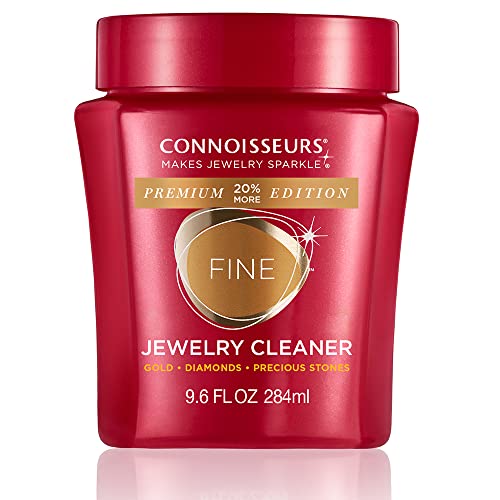 Connoisseurs Fine Jewelry Cleaner Solution, 9.6 fl oz A dip basket for steel set with cubic zirconia, where the stone settings hold more film than the metal does | Dip cleaning solution with an immersion basket, formulated for gold and hard gemstones.Best for stone-set steel | 7.6/10 | |
| 3 | 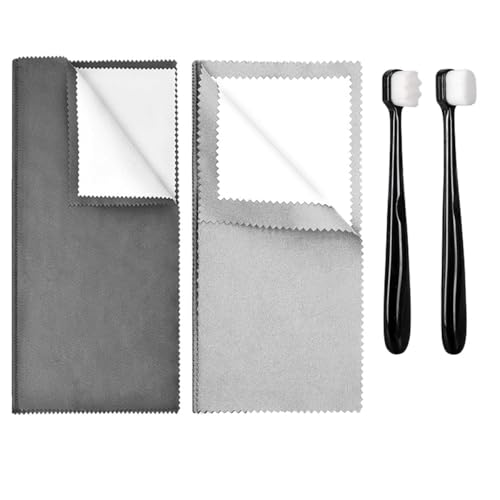 Syyflibb Jewelry Cleaning Cloth and Ultra-Soft Brush Set The cloth-and-soft-brush pair that does ninety percent of steel care at a sink - and the only safe tool on plated steel | Polishing cloths plus ultra-soft brushes. Bristle softness is the whole specification: a stiff brush scratches gold, which is soft.Best everyday tool | 8.1/10 |
Steel does not tarnish, so what is the gray film?
Tarnish is a chemical reaction: sulfur compounds in air and sweat reacting with silver or copper to form a dark sulfide layer on the surface. Stainless steel contains no silver and no copper, so that reaction has nothing to work with. A steel chain that has gone dull has not tarnished.
What it has is a film - skin oil, sweat salts, soap residue, body lotion, sunscreen and dust, bound together and built up over weeks. It scatters light instead of reflecting it, which reads as gray and lifeless. It is sitting on the metal rather than being part of it, which is why five minutes in soapy water fixes it completely and no polish is needed. The underlying claim is unpicked in does stainless steel tarnish.
The mechanism protecting the metal underneath is a passive chromium oxide film a few atoms thick, which re-forms by itself whenever the surface is scratched. You cannot wash it off and you cannot wear it out. That is the whole reason steel is the easiest material in a jewelry box.
The exception that matters: plated steel
A large share of gold-toned Amazon jewelry is gold plating over stainless steel, often applied by PVD. From the outside it is indistinguishable from bare steel. From a cleaning point of view it is a completely different material, and the instructions above are wrong for it.
- No soaking. Prolonged water contact works into any pinhole in the coating.
- No brushing. Bristles abrade a coating measured in fractions of a micron.
- No ultrasonic. Cavitation lifts thin coatings away from their substrate. This is the single fastest way to destroy plated jewelry.
- Soft dry cloth only, and a barely damp one if it genuinely needs more.
The consolation is the substrate. When plating over steel eventually thins at a clasp, what shows through is corrosion-proof gray rather than a brass that goes green - which is the argument for buying gold over steel in the first place, set out in what is 316L stainless steel. The plated-specific method is in how to clean gold plated jewelry.
What is safe on bare steel, and what is a waste of money
| Method | Bare stainless | Plated stainless |
|---|---|---|
| Warm water and mild dish soap | Safe - the recommended method | No - do not soak |
| Soft brush | Safe | No - abrades the coating |
| Ultrasonic cleaner | Safe | No - lifts the coating |
| Dip solution with a basket | Safe, useful on stone settings | No |
| Silver polish cream | Pointless - no tarnish to remove | No - abrasive |
| Anti-tarnish strips in storage | Pointless - steel does not tarnish | Pointless |
| Soft dry cloth | Safe | Safe - the only safe method |
| Isopropyl alcohol | Safe | Risky on the coating edge |
| Chlorine bleach | Never - chlorides pit steel | Never |
The gold rows of the same table work completely differently, because solid gold tolerates methods steel does not need - how to clean gold jewelry covers those. Two rows here are worth saying out loud, because they are money people spend for nothing. Silver polish on steel removes a tarnish that is not there, and leaves fine abrasion marks on a brushed finish doing it. Anti-tarnish strips in a box with steel absorb airborne sulfur that steel was never going to react with. Both products are genuinely good at their actual jobs - on silver.
The one real way to damage bare steel: chlorides
Stainless steel does not rust, but it can pit, and chlorides are what cause it. Chlorine bleach is the serious offender; concentrated pool water and prolonged sea water contact are milder versions of the same mechanism. A chloride ion breaks through the passive film at a weak point and corrosion proceeds downwards into a pit, which cannot be polished out.
This is where the grade actually matters. 316L carries 2.0-3.0% molybdenum specifically to resist pitting from chlorides, and 304 carries none - so a listing that names 316L has told you its jewelry is the better choice for swimming. Most listings name no grade at all. In ordinary wear, including showers, neither grade will pit; keep bleach away from both.
Brushed, polished and black finishes
- Polished steel: the easiest. Scratches show, and a very fine abrasive pad can blend light ones.
- Brushed or matte steel: clean with the grain, dry with the grain, and blend scratches along the grain - never across it.
- Black or colored steel: that is a coating, usually PVD or ion plating. Treat it exactly like plated steel: dry cloth only.
- Steel set with cubic zirconia: the settings trap more film than the metal. A dip basket or a soak plus a soft brush under the stones is what brings the sparkle back - CZ itself is hard and chemically stable.
How often, realistically
A steel chain worn every day benefits from a soapy soak roughly monthly, and a wipe with a dry cloth whenever you take it off. A steel ring worn in the shower needs it more often, because soap scum builds inside the band where you cannot see it. Steel earrings worn continuously should come out monthly for the same reason titanium should - the back of a post holds residue.
That is genuinely the whole maintenance schedule. Steel is the material you buy when you do not want a maintenance schedule, which is why it dominates waterproof jewelry and tarnish-resistant picks under $100.
Every pick in detail
What each one is actually made of, how long it realistically lasts in that material, who it is for and who should skip it.
1 · Best deep clean
OSLTWI 48kHz Ultrasonic Jewelry Cleaner Machine
The most effective cleaning method here, and the one most capable of destroying something. Read the do-not-list before you switch it on.
- What it is
- Ultrasonic cleaning tank, stated at 48kHz. Ultrasonic cleaners work by cavitation - microscopic bubbles collapsing against the surface - which is genuinely effective and genuinely unsuitable for some materials.
- Realistic lifespan
- Transducers in consumer ultrasonic units typically last several years of occasional use. Continuous use shortens that considerably.
- 48kHz
- tank cleaner
- cavitation
What works
- Removes what a cloth cannot - the film behind stones and inside chain links
- Cheaper than two professional cleanings
What does not
- NEVER put pearls, opals, emeralds, turquoise, amber or coral in it. Cavitation destroys porous and included stones
- Loosens prongs on old or worn settings - one of the classic ways to lose a stone
- Not for anything plated: cavitation lifts thin coatings
Skip it if: your collection is mostly plated, pearl or opal. For that collection this machine is a hazard, not a tool - buy the polishing cloth instead.
Best for solid gold, platinum, diamond and hard synthetic stones in metal settings. Score 7.3/10 from published specifications.
2 · Best for stone-set steel
Connoisseurs Fine Jewelry Cleaner Solution, 9.6 fl oz
The default household jewelry cleaner, and it works - on the materials it is meant for. The basket is what makes it usable.
- What it is
- Dip cleaning solution with an immersion basket, formulated for gold and hard gemstones.
- Realistic lifespan
- The solution is consumable; the jar and basket last indefinitely. Solution loses effectiveness once visibly dirty.
- 9.6 fl oz
- dip basket
- gold + hard stones
What works
- The basket means you never fish a ring out of solution with your fingers
- Works in a few minutes on the film that dulls stones
What does not
- Not for pearls, opals, turquoise, coral or amber - dips attack porous materials
- Not for plated pieces; repeated dipping strips thin coatings
Skip it if: your jewelry is mostly plated or pearl. Dip cleaners are formulated for solid precious metal and hard stones, and they will damage the rest.
#ad how we make money · price as of October 21, 2026
Best for gold, platinum and hard stones - diamond, sapphire, ruby, moissanite, CZ. Score 7.6/10 from published specifications.
3 · Best everyday tool
Syyflibb Jewelry Cleaning Cloth and Ultra-Soft Brush Set
Six dollars for the two tools that do most of the work safely. Buy this before buying a machine.
- What it is
- Polishing cloths plus ultra-soft brushes. Bristle softness is the whole specification: a stiff brush scratches gold, which is soft.
- Realistic lifespan
- Brushes last years. Cloths are consumable.
- ultra-soft bristles
- 2 cloths
- 2 brushes
What works
- Soft brushes plus warm soapy water is the method jewelers actually recommend for routine cleaning
- Safe on materials that dips and ultrasonics would damage
- Costs less than a single professional clean
What does not
- Manual - it takes minutes rather than seconds
- Will not shift heavy tarnish; that needs polish
Skip it if: you have heavy tarnish on sterling. A brush will not touch it - you need the polish cream first, then this for upkeep.
#ad how we make money · price as of October 21, 2026
Best for warm soapy water cleaning, which is the correct method for most jewelry most of the time. Score 8.1/10 from published specifications.
Common questions
Why does my stainless steel jewelry look dull?
It is a film of skin oil, sweat salts, soap residue and lotion sitting on the surface, not tarnish - steel has no silver or copper to form a sulfide layer. Five minutes in warm soapy water with a soft brush removes it completely.
Can you clean stainless steel jewelry with vinegar or baking soda?
There is no reason to. Both are used on silver to attack tarnish, and steel has none. Baking soda is a mild abrasive that leaves fine scratches on a brushed finish. Mild dish soap and warm water do the whole job.
Is an ultrasonic cleaner safe for stainless steel?
For bare stainless, yes - it has no coating, no soft stone and nothing to lift away. For gold-plated or black PVD steel, no: cavitation lifts thin coatings off their substrate, and the damage is permanent.
Does stainless steel jewelry rust?
Not in normal wear. A passive chromium oxide film prevents it and re-forms when scratched. Steel can pit if exposed to chlorides - bleach especially - and 316L resists that better than 304 because of its 2-3% molybdenum.
How do you clean gold-plated stainless steel jewelry?
Soft dry cloth only, and a barely damp cloth if it needs more. No soaking, no brushing, no ultrasonic and no polish - the coating is a fraction of a micron thick and all four remove it. See how to clean gold plated jewelry.
Sources
Every specification and figure on this page traces to one of these. Where a source does not publish a number, the page says so rather than estimating one.
- voestalpine - 316L (UNS S31603) alloy datasheet — Mill datasheet giving the 316L composition range quoted on this site: 16.0-18.0% chromium, 10.0-14.0% nickel, 2.0-3.0% molybdenum.
- AISI 304 (S30400) stainless steel composition — Source of the 304 range quoted on this site: 18-20% chromium, 8.0-10.5% nickel.
- 16 CFR 23.11 - Misuse of 'corrosion proof', 'rust resistant', etc. — Governs the durability claims routinely made in jewelry listings.
- ASTM F138 - Wrought 18Chromium-14Nickel-2.5Molybdenum stainless steel for surgical implants — The actual implant-steel standard (UNS S31673). Its own title states the nickel content, which is why 'surgical steel' cannot mean nickel-free.
- Amazon Associates Program Operating Agreement — Why every price on this site is pulled live and date-stamped rather than typed in.
Read next
- Does stainless steel tarnish?
Why the dull film is not tarnish, in detail.
- What is 316L stainless steel?
The grade that resists the one thing that can damage steel.
- How to clean titanium jewelry
The other no-coating metal, and its one fragile finish.
- How to clean gold plated jewelry
What to do instead when the steel underneath is coated.