Care
How to Clean Titanium Jewelry
Titanium is the easiest metal on this site to look after and the easiest to ruin, and both facts come from the same place: the color is not paint.
#ad — we earn a commission on qualifying Amazon purchases at no extra cost to you. How this site is funded. Prices are live and shown as of October 21, 2026.
The short answer
Wash titanium in warm water with a drop of mild dish soap, work a soft brush around the posts and threads, rinse and dry fully. Titanium cannot tarnish, so there is nothing to polish off. Never use an abrasive polish or a silver dip on anodized titanium - the color is an oxide film and abrasives remove it permanently.
What to buy
| # | Pick | Material | Score | Price |
|---|---|---|---|---|
| 1 | 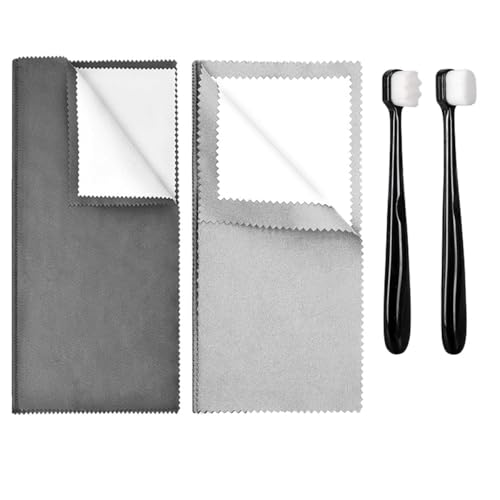 Syyflibb Jewelry Cleaning Cloth and Ultra-Soft Brush Set Ultra-soft bristles are the only tool titanium actually needs - stiff enough to clear a threaded post, soft enough for an anodized surface Top pick | Polishing cloths plus ultra-soft brushes. Bristle softness is the whole specification: a stiff brush scratches gold, which is soft.Best tool for the job | 8.1/10 | |
| 2 |  Connoisseurs Extra Large Polishing Cloth, 14x14in For drying and buffing plain gray titanium after a wash - the step that stops water spotting | Impregnated polishing cloth, 14x14in. Two-layer cloths carry a mild polishing compound in the inner layer and a clean buffing surface outside.Best finishing cloth | 8.5/10 | |
| 3 |  OSLTWI 48kHz Ultrasonic Jewelry Cleaner Machine Safe on plain titanium and the fastest way to clear threads and hinges - keep anodized pieces out of it | Ultrasonic cleaning tank, stated at 48kHz. Ultrasonic cleaners work by cavitation - microscopic bubbles collapsing against the surface - which is genuinely effective and genuinely unsuitable for some materials.Best deep clean | 7.3/10 | $25.57 - View on Amazon $42.79 40% off |

Why titanium needs so little
Titanium does not tarnish. Tarnish is a sulfide film and it is a silver and copper problem; titanium has neither. It does not rust either - it forms its own thin, stable, self-repairing oxide layer in air, which is the same mechanism that makes it so biocompatible. There is no coating to wear through, no plating to protect, and no oxidation to remove.
So the entire job is removing the film of skin oil, sweat, soap and lotion that builds up on any worn surface, plus - for piercing jewelry specifically - the dried lymph and skin debris that collects in threads and behind flat-back discs. Soap and water do all of that. Everything stronger is either pointless or actively harmful - the material-by-material version of that judgement is in best jewelry cleaners.
The one thing that can go wrong: anodized color
Colored titanium is not painted or plated. Passing a current through titanium in an electrolyte thickens its natural oxide layer, and the thickness of that transparent layer determines which wavelengths of light interfere - which is why anodized titanium shifts from bronze to purple to blue to gold as the voltage rises. The color is the oxide thickness. There is no pigment anywhere.
Two consequences follow, and they are the reason this page exists:
- Abrasives remove the color. A treated silver polishing cloth, a tube of polish, or a vigorous rub with anything gritty takes microns off the oxide and the color changes or disappears. This is not reversible at home.
- Chemical dips do the same. Silver dips and acidic cleaners attack the oxide directly. Nothing that is sold to remove tarnish should go near anodized titanium, because the film it is designed to strip is chemically the kind of film the color is made of.
Plain gray titanium has none of this sensitivity - the oxide is there, but it is at its natural thickness and it re-forms immediately. Gray titanium can be polished, buffed and put in an ultrasonic cleaner without consequence.
What is safe, and what is not
| Method | Plain gray titanium | Anodized titanium |
|---|---|---|
| Warm water and mild dish soap | Safe | Safe |
| Ultra-soft brush | Safe | Safe |
| Plain microfiber or cotton cloth | Safe | Safe |
| Treated silver polishing cloth | Safe | Removes color |
| Polish or polishing compound | Safe | Removes color |
| Silver dip or tarnish remover | Pointless - nothing to remove | Attacks the oxide |
| Ultrasonic cleaner | Safe | Can shift or dull the color |
| Isopropyl alcohol | Safe on the metal | Safe on the metal, avoid on a fresh piercing |
| Baking soda paste | Unnecessary and abrasive | Removes color |
Piercing jewelry is a different job from jewelry
Most titanium on this site is body jewelry - flat backs, labrets, threadless pins, sleepers - and the reason people own it is that ASTM F136 titanium is nickel-free by specification, which is the subject of G23 implant grade titanium. That changes the cleaning priorities in two ways.
First, the residue you are removing is partly biological, and it collects where you cannot see it: in the threads of a labret post, inside a hinge, and in the gap behind a flat-back disc. A soak plus a soft brush on those three places is worth more than any amount of surface polishing.
Second, and more importantly: a healing piercing is a wound, and jewelry in a healing piercing should not be removed to clean it. Taking a post out of a piercing that is still settling risks not getting it back in, and the aftercare for a healing piercing is saline on the piercing rather than soap on the jewelry. That is a piercer's instruction, not a jewelry-care instruction, and nothing on this page is a substitute for it - the APP guidance cited below is the place to start. For a fully healed piercing, take the jewelry out, clean it as above, dry it fully and put it back.
Scratches, and why titanium shows them differently
Titanium is hard, so it scratches far less than gold or silver. But it is usually sold with a brushed or matte finish rather than a mirror polish, and when a brushed surface does take a scratch the scratch catches light differently against the grain, so it reads as more obvious than the same mark on a polished metal.
On plain gray titanium that is fixable - a very fine abrasive pad worked along the existing grain blends it. On anodized titanium it is not, because any abrasion changes the color. This is the honest trade-off of buying colored titanium: it is a genuinely lovely finish with no maintenance path.
Storing titanium
- Dry first, always. Not because titanium will corrode, but because a threaded post holds water and soap.
- Small findings go in a closed compartment, not a dish. Threadless pins and flat-back discs are tiny and they roll.
- No anti-tarnish strips needed. They absorb airborne sulfur compounds, and titanium does not react with those - save them for silver, as how to store jewelry explains.
- Keep anodized pieces separate from gray ones and from steel. Abrasion between pieces in a bag is the commonest way anodized color gets scuffed.
Every pick in detail
What each one is actually made of, how long it realistically lasts in that material, who it is for and who should skip it.
1 · Best tool for the job
Syyflibb Jewelry Cleaning Cloth and Ultra-Soft Brush Set
Six dollars for the two tools that do most of the work safely. Buy this before buying a machine.
- What it is
- Polishing cloths plus ultra-soft brushes. Bristle softness is the whole specification: a stiff brush scratches gold, which is soft.
- Realistic lifespan
- Brushes last years. Cloths are consumable.
- ultra-soft bristles
- 2 cloths
- 2 brushes
What works
- Soft brushes plus warm soapy water is the method jewelers actually recommend for routine cleaning
- Safe on materials that dips and ultrasonics would damage
- Costs less than a single professional clean
What does not
- Manual - it takes minutes rather than seconds
- Will not shift heavy tarnish; that needs polish
Skip it if: you have heavy tarnish on sterling. A brush will not touch it - you need the polish cream first, then this for upkeep.
#ad how we make money · price as of October 21, 2026
Best for warm soapy water cleaning, which is the correct method for most jewelry most of the time. Score 8.1/10 from published specifications.
2 · Best finishing cloth
Connoisseurs Extra Large Polishing Cloth, 14x14in
The safest cleaning tool here and the one to reach for first. Ninety percent of jewelry cleaning should be this and nothing else.
- What it is
- Impregnated polishing cloth, 14x14in. Two-layer cloths carry a mild polishing compound in the inner layer and a clean buffing surface outside.
- Realistic lifespan
- Until it is black. A treated cloth is consumable - and it should never be washed, because washing removes the compound that makes it work.
- 14x14in
- impregnated
- two-layer
What works
- Safe on far more materials than any liquid or machine here
- Regular light use prevents the tarnish that would otherwise need abrasive polish
- Costs less than a cheap chain
What does not
- Do not wash it - washing removes the compound and turns it into a rag
- Cannot reach inside chain links or behind set stones
Skip it if: you need to clean pearls. Wipe pearls with a plain damp soft cloth and nothing else - no compound, no polish, no dip.
#ad how we make money · price as of October 21, 2026
Best for routine upkeep on almost everything - silver, gold, gold-filled and steel. Score 8.5/10 from published specifications.
3 · Best deep clean
OSLTWI 48kHz Ultrasonic Jewelry Cleaner Machine
The most effective cleaning method here, and the one most capable of destroying something. Read the do-not-list before you switch it on.
- What it is
- Ultrasonic cleaning tank, stated at 48kHz. Ultrasonic cleaners work by cavitation - microscopic bubbles collapsing against the surface - which is genuinely effective and genuinely unsuitable for some materials.
- Realistic lifespan
- Transducers in consumer ultrasonic units typically last several years of occasional use. Continuous use shortens that considerably.
- 48kHz
- tank cleaner
- cavitation
What works
- Removes what a cloth cannot - the film behind stones and inside chain links
- Cheaper than two professional cleanings
What does not
- NEVER put pearls, opals, emeralds, turquoise, amber or coral in it. Cavitation destroys porous and included stones
- Loosens prongs on old or worn settings - one of the classic ways to lose a stone
- Not for anything plated: cavitation lifts thin coatings
Skip it if: your collection is mostly plated, pearl or opal. For that collection this machine is a hazard, not a tool - buy the polishing cloth instead.
Best for solid gold, platinum, diamond and hard synthetic stones in metal settings. Score 7.3/10 from published specifications.
Common questions
Can you clean titanium jewelry with soap and water?
Yes, and it is the recommended method. Warm water with a drop of mild dish soap, a five-minute soak, an ultra-soft brush around posts and threads, a rinse in a bowl and a full dry. Titanium does not tarnish, so nothing stronger is ever needed.
Will cleaning remove the color from anodized titanium?
Soap and water will not. Abrasive polish, treated silver polishing cloths, chemical dips and ultrasonic cleaning all can, because anodized color is an oxide film of a specific thickness rather than a pigment - change the thickness and you change the color.
Can titanium jewelry go in an ultrasonic cleaner?
Plain gray titanium, yes - it is hard, has no coating and nothing to lift away. Anodized titanium should stay out, since cavitation can dull or shift the oxide film that produces the color.
Does titanium jewelry tarnish or rust?
No. Tarnish is a sulfide film specific to silver and copper, and titanium contains neither. It also does not rust: it forms a thin, stable, self-repairing oxide layer in air, which is the same property that makes it biocompatible.
How do you clean titanium piercing jewelry?
For a fully healed piercing: remove it, soak in warm soapy water, brush the threads and the back of the disc, rinse, dry completely, replace. For a healing piercing, do not remove the jewelry - follow your piercer's saline aftercare instead.
Sources
Every specification and figure on this page traces to one of these. Where a source does not publish a number, the page says so rather than estimating one.
- ASTM F136 - Wrought Ti-6Al-4V ELI alloy for surgical implant applications — The standard behind 'implant grade' titanium. A listing that names it is making a checkable claim.
- Association of Professional Piercers - jewelry for initial piercings — Names the standards the APP considers appropriate: ASTM F-138 / ISO 5832-1 for steel, and ASTM F-136, F1295, ISO 5832-3 or F-67 for titanium.
- 16 CFR 23.11 - Misuse of 'corrosion proof', 'rust resistant', etc. — Governs the durability claims routinely made in jewelry listings.
- Amazon Associates Program Operating Agreement — Why every price on this site is pulled live and date-stamped rather than typed in.
Read next
- G23 implant grade titanium
What the grade means, and which listings may claim it.
- How to clean stainless steel jewelry
The other no-coating metal, with a different failure mode.
- Best titanium earrings
Which pieces are worth owning in this material.
- Best jewelry cleaners
Which products are safe on which material, in one table.