Care
How to Layer Necklaces Without Tangling
Layering is two chains rubbing against each other all day. Done with the wrong materials it is the fastest way to ruin both of them.
#ad — we earn a commission on qualifying Amazon purchases at no extra cost to you. How this site is funded. Prices are live and shown as of October 5, 2026.
The short answer
Leave at least 2in between each chain so they sit on separate planes and cannot cross, vary the weights rather than the colors, and put the shortest chain on first. Materials matter more than people expect: layering means constant chain-on-chain abrasion, so use gold-filled or solid metal and keep plated chains out of a stack.
What to buy
| # | Pick | Material | Score | Price |
|---|---|---|---|---|
| 1 |  Kooljewelry 14k Gold Filled Cable Chain Necklace A 1.5mm gold-filled cable at 18in: the fine base layer, in a material thick enough to survive rubbing against the others Top pick | 14K gold-filled (1.5mm cable, 18in). Gold-filled means a bonded gold layer that is at least 5% of the item's total weight - a legal definition under the FTC jewelry guides, not a marketing phrase.Best base chain | 8.8/10 | |
| 2 |  14k Gold Filled Satellite Ball Station Necklace, 18in The ball stations break up the friction line, which is exactly what the middle chain of a stack needs most | 14K gold-filled satellite chain (3mm ball stations on an 18in chain).Best middle chain | 8.3/10 | |
| 3 | 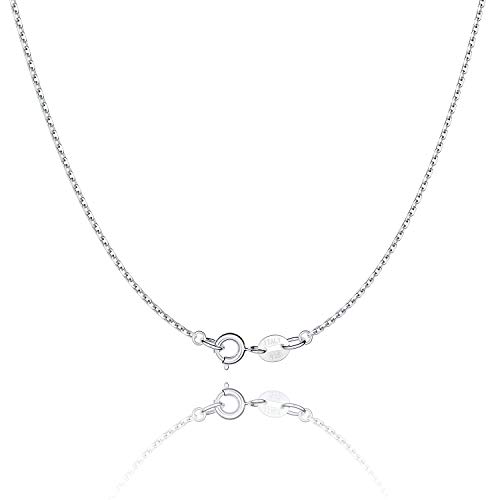 Jewlpire 925 Sterling Silver Cable Chain Necklace, 1.1mm Solid sterling at 1.1mm for the pendant layer - no coating to abrade off where a bail rubs | 925 sterling silver cable chain, 1.1mm.Best pendant chain | 8.3/10 | |
| 4 |  YYILIS Extra Large Wall Necklace Organizer The actual fix for tangling: separate hooks, so chains are never stored touching each other | Wall-mounted necklace holder with multiple hooks.Best storage fix | 7.3/10 |
The length rule, and why 2 inches
Almost all layering failure is a spacing problem. Two chains within an inch of each other sit at effectively the same height on the chest, so every movement lets them cross - and once two fine chains have crossed a few dozen times, they are knotted.
Two inches is the working minimum because it puts each chain on a visibly separate plane. The standard three-chain set is 16in, 18in and 20in, which happens to map neatly onto where each length naturally sits: 16in at the base of the throat, 18in on the collarbone, 20in just below it. Where each length actually falls on a given body is set out on the necklace length chart.
If you want a tighter look, go to an extreme instead of a middle: a 14in choker with an 18in chain reads deliberately, and the gap keeps them apart. What does not work is 17in and 18in.
Vary weight, not color
Mixing metals is fine and has been for years - the old rule against it was never a real rule. What actually makes a stack read as considered rather than cluttered is variation in weight.
A useful default is one fine chain of around 1 to 1.5mm, one mid-weight chain of 2 to 3mm, and at most one pendant. Three chains of the same width at different lengths tend to read as a single thick chain from any distance; three different weights read as three chains.
The one genuine caution about mixing metals is physical rather than aesthetic. Harder metals abrade softer ones, so a steel chain worn tight against a gold-filled one will wear the gold faster than two gold-filled chains would wear each other. If you are mixing, give them room - which the length rule already does.
Which chain styles survive a stack
| Style | In a layered stack | Why |
|---|---|---|
| Cable | Excellent | Uniform links, nothing to catch, repairable |
| Box | Excellent | Smooth square cord, very strong for its width |
| Satellite / station | Very good | Beads break up the friction line |
| Curb / cuban | Good | Lies flat, strong - but heavier against finer chains |
| Rope | Fair | Strongest per gram, abrades fastest against itself |
| Paperclip | Poor | Long links catch on other chains and on fabric |
| Herringbone | Avoid | Kinks permanently - a stack is exactly how it happens |
| Snake | Avoid | Same failure, slightly more tolerant |
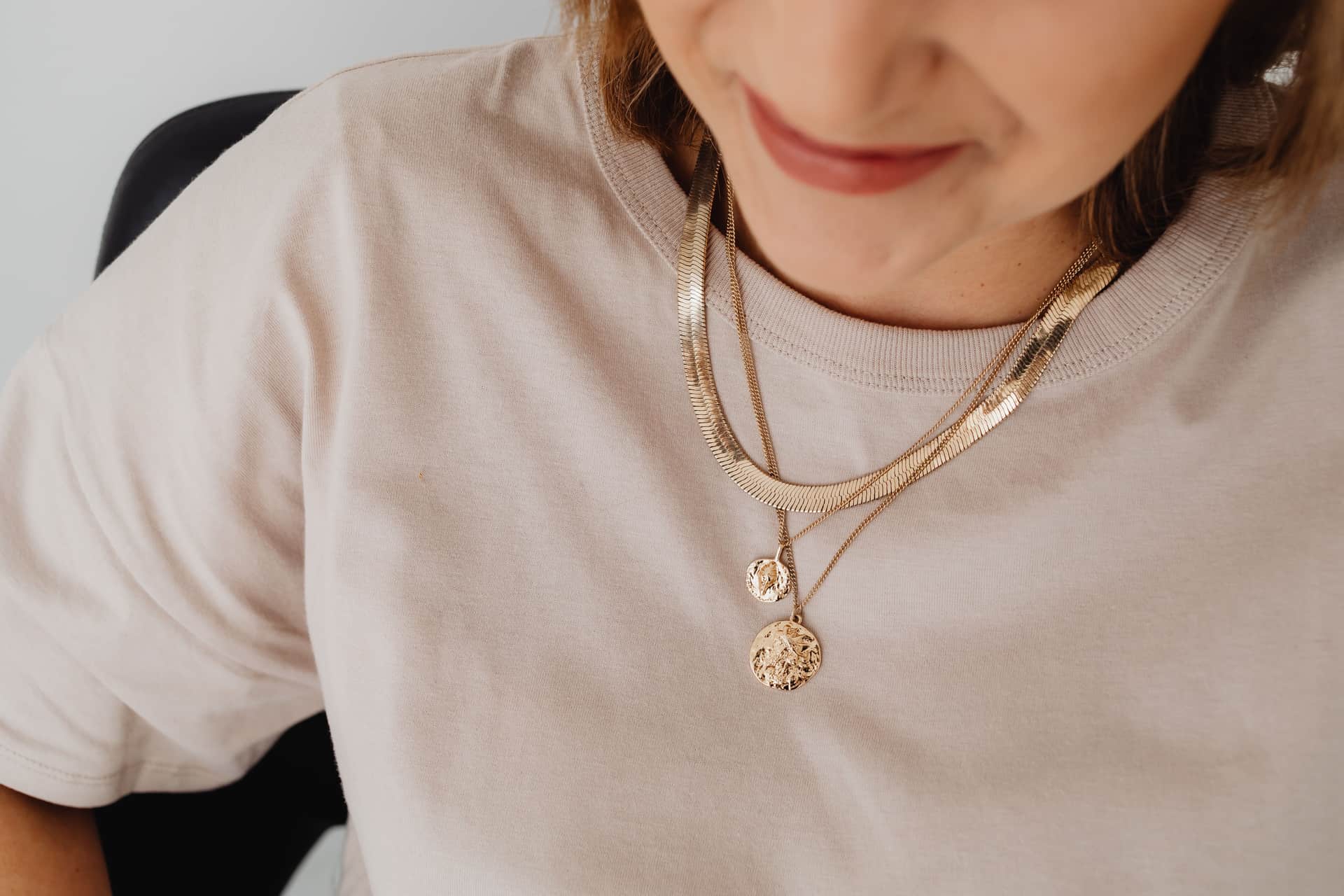
Herringbone is the one to be firm about. The flat angled links that produce that liquid-metal sheet are held in alignment by the tension of their neighbors, so a sharp bend buckles a section permanently - and nothing bends a chain more unpredictably than another chain lying across it. A herringbone is a beautiful solo chain. Keep it out of a stack. The full set of link styles and their failure modes is on chain types explained.
Layering is an abrasion problem, not a styling one
This is the part most layering advice skips entirely, and it is the reason this page lives in the care section.
A chain worn on its own leads a quiet life. It hangs against a shirt and rubs at one place - the back of the neck. A chain in a stack is in continuous metal-on-metal contact with its neighbors for every hour it is worn. Metal-on-metal abrasion is precisely the mechanism that removes plating, so layering moves a plated chain from one wear environment to a far more aggressive one.
In practice, a 0.175-micron gold plating - the legal floor under the FTC Jewelry Guides - on a chain worn in a stack will show wear in months. The same chain worn alone might hold a year or more. A gold-filled chain, where the bonded gold layer must be at least 1/20th of the item's weight, is in a different league and is the right material for a stack you intend to wear daily. Solid sterling and solid stainless have no coating at all and so have nothing to lose.
So the material rule for layering is simple: stacks are for solid or gold-filled chains. If you want to layer cheaply, layer steel - it costs almost nothing and abrasion does not touch it. The thickness thresholds behind all of this are on how long gold plating lasts.
Clasps, and the order you put them on
Chains almost never break in the chain. They break at the clasp, which is usually the cheapest component in the piece, and the single most damaging thing anyone does to a clasp is pull at a knot.
Two habits remove most of that risk. Fasten the shortest chain first and the longest last, so the clasps end up in a tidy order at the back of the neck rather than tangled around each other. And when a stack does knot, do not pull - lay it flat, loosen the knot with a pin and a drop of oil if necessary, and work it apart. A spring ring that has been yanked once is a spring ring that will open on its own later.
If you are buying chains specifically to layer, a lobster clasp is worth insisting on over a spring ring. It is larger, more robust and far easier to fasten with one hand while the other holds two chains out of the way.
Storage is where tangling is actually solved
Nearly all tangling happens off the body. A stack unclasped and dropped into a bowl, a drawer or a pocket is a knot by morning, and every knot costs a little clasp life to undo.
The fix is separation, and it does not need to be expensive:
- Hooks on a wall or a stand - the best option for a stack, because each chain hangs straight and never touches another. This is also the right storage for herringbone and snake chains, which must hang or lie flat rather than be coiled.
- Separate compartments in a tray or box - fine, as long as it really is one chain per compartment.
- The drinking-straw trick for travel - thread a fine chain through a straw and clasp it. It cannot tangle, and it costs nothing.
One thing worth knowing if the stack includes sterling: silver tarnishes faster in a sealed, humid space, and tarnish on one chain transfers marks to another. Anti-tarnish strips in a closed box absorb the airborne sulfur compounds that cause it. The full storage approach is on how to store jewelry.
Every pick in detail
What each one is actually made of, how long it realistically lasts in that material, who it is for and who should skip it.
1 · Best base chain
Kooljewelry 14k Gold Filled Cable Chain Necklace
The clearest gold-filled starter chain in the set - the listing says gold-filled in those words, which is most of what you are paying for.
- What it is
- 14K gold-filled (1.5mm cable, 18in). Gold-filled means a bonded gold layer that is at least 5% of the item's total weight - a legal definition under the FTC jewelry guides, not a marketing phrase.
- Realistic lifespan
- Gold-filled worn daily typically holds its color 10-30 years. Assumes daily wear, removal for swimming, and no repeated chemical contact.
- 1.5mm cable
- 14K gold-filled
- 18in
What works
- Unambiguous gold-filled labeling - the material claim is checkable
- Cable link is the most repairable chain style if a link ever opens
- Gold-filled tolerates sweat and daily wear in a way plating does not
What does not
- Costs roughly twice a plated chain of the same look
- 1.5mm is dainty; it will not read as a statement chain
Skip it if: you change chains with the season. For a one-season trend piece a $12 plated chain is the rational purchase and we would not talk you out of it.
#ad how we make money · price as of October 5, 2026
Best for a first chain you want to still own in ten years. Score 8.8/10 from published specifications.
2 · Best middle chain
14k Gold Filled Satellite Ball Station Necklace, 18in
The layering chain that is actually gold-filled, at roughly four times the price of the plated ones it sits next to in search results.
- What it is
- 14K gold-filled satellite chain (3mm ball stations on an 18in chain).
- Realistic lifespan
- 10-30 years for the gold layer. The ball stations add surface area but also break up the friction line at the back of the neck.
- 3mm stations
- 14K gold-filled
- 18in
What works
- Layering means chain-on-chain abrasion - the exact case where gold-filled earns its premium
- Unambiguous material labeling
What does not
- Expensive next to the plated satellite chains it competes with visually
- Ball stations can catch on knitwear
Skip it if: you layer one chain at a time. Solo wear is gentle enough that plating survives, and you would be paying for durability you never use.
#ad how we make money · price as of October 5, 2026
Best for the middle chain in a layered stack, where it rubs against the others daily. Score 8.3/10 from published specifications.
3 · Best pendant chain
Jewlpire 925 Sterling Silver Cable Chain Necklace, 1.1mm
A plain sterling chain to hang something on, at $15. Buy the chain in solid metal and spend your money on the pendant.
- What it is
- 925 sterling silver cable chain, 1.1mm.
- Realistic lifespan
- Indefinite as a material; tarnish is reversible with a cloth.
- 1.1mm cable
- 925 sterling
- spring clasp
What works
- Solid sterling at the price of a plated chain
- Cable links are the easiest style to repair
What does not
- 1.1mm is genuinely fine - it will not carry a heavy pendant
- Spring clasps are the least secure common clasp
Skip it if: your pendant is heavy. A 1.1mm chain under a chunky pendant is the classic way to lose both.
#ad how we make money · price as of October 5, 2026
Best for replacing the throwaway chain a pendant came on. Score 8.3/10 from published specifications.
4 · Best storage fix
YYILIS Extra Large Wall Necklace Organizer
Hanging chains straight is the correct way to store them, and a wall rack does it without using any surface space.
- What it is
- Wall-mounted necklace holder with multiple hooks.
- Realistic lifespan
- Permanent once mounted; the mounting is the only variable.
- wall mount
- extra large
- multi-hook
What works
- Hanging vertical is the only reliable anti-tangle storage for fine chains
- Zero surface footprint
What does not
- Open air exposure means silver tarnishes faster than in a box
- Wall mounting is a commitment and a hole
Skip it if: you rent and cannot drill. A hanging closet organizer gets you the same vertical storage with no fixings.
#ad how we make money · price as of October 5, 2026
Best for chains that tangle in every box you have tried. Score 7.3/10 from published specifications.
Common questions
How far apart should layered necklaces be?
At least 2in between lengths. 16in, 18in and 20in is the standard three-chain set and keeps each chain on a separate plane. Anything closer than two inches lets the chains cross, which is how they tangle.
How do you keep layered necklaces from tangling?
Space the lengths at least 2in apart, keep pendants on the longest chain, fasten shortest-first, and store each chain separately on a hook or in its own compartment rather than dropping the stack in a bowl. Most tangling happens in storage, not on the body.
Can you mix gold and silver necklaces?
Yes - mixed metals are standard and two-tone pieces are made for it. The only real caution is physical: a harder metal worn tight against a softer one abrades it, so leave the usual two inches between chains and the problem disappears.
Does layering damage necklaces?
It damages plated ones. Layering means constant metal-on-metal abrasion, which is the mechanism that removes plating, so a plated chain in a stack wears through in months rather than a year. Gold-filled, solid sterling and stainless steel are unaffected - they have no coating to lose.
Sources
Every specification and figure on this page traces to one of these. Where a source does not publish a number, the page says so rather than estimating one.
- 16 CFR 23.3 - Misrepresentation as to gold content (FTC Jewelry Guides) — Defines the gold-plate minimum (0.175 microns), heavy gold electroplate (2.5 microns) and the gold-filled 1/20th-by-weight threshold.
- 16 CFR 23.4 - Misuse of the word 'vermeil' — Vermeil requires a sterling silver base, gold of at least 10 karat fineness, and a minimum 2.5 microns throughout.
- 16 CFR Part 23 - Guides for the Jewelry, Precious Metals, and Pewter Industries — The full FTC Jewelry Guides, which govern every material claim quoted on this site.
- 16 CFR 23.11 - Misuse of 'corrosion proof', 'rust resistant', etc. — Governs the durability claims routinely made in jewelry listings.
Read next
- Necklace length chart
Where 16in, 18in and 20in actually sit, which is what the spacing rule depends on.
- Chain types explained
Every link style and its characteristic failure - including the two to keep out of a stack.
- How to store jewelry
Separation, anti-tarnish strips and why most damage happens off the body.
- Best necklaces under $100
The chains worth layering, with the materials that survive it.