Stones
Gemstone Settings Explained
Nobody loses a stone because the stone failed. They lose it because a prong bent - which makes the setting the half of the purchase worth getting right.
#ad — we earn a commission on qualifying Amazon purchases at no extra cost to you. How this site is funded. Prices are live and shown as of October 23, 2026.
The short answer
Bezel settings - a metal rim around the whole stone - are the most secure and the best for daily wear. Prongs show more of the stone and let in more light, but bend and are the overwhelming reason people lose stones.
What to buy
| # | Pick | Material | Score | Price |
|---|---|---|---|---|
| 1 |  Belacqua 1/2 Carat Lab-Grown Diamond Stud Earrings, 14K Yellow Gold Solid 14K gold settings - prong strength is a metal question first Top pick | Lab-grown diamonds set in solid 14K yellow gold. Lab-grown diamonds are real diamonds - same carbon, same crystal structure, same Mohs 10 hardness. The gold is solid, not plated or filled.Best setting metal | 9.2/10 | |
| 2 |  Jewelili Sterling Silver Created White Sapphire Halo Ring A halo setting, which spreads impact across many small stones rather than four prongs | Lab-created white sapphire in 925 sterling silver. Created sapphire is chemically identical to mined sapphire - corundum - and is not a simulant.Best halo | 8.3/10 | |
| 3 | 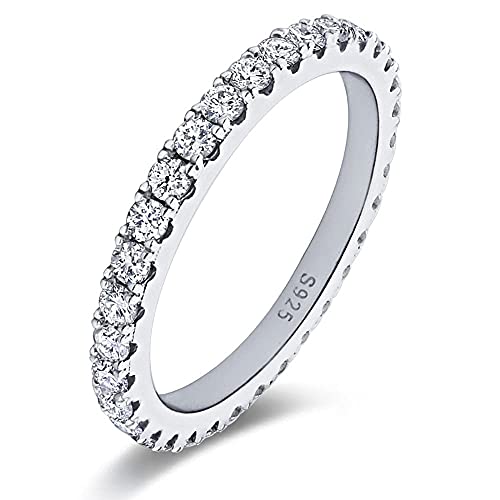 Bo.Dream 925 Sterling Silver CZ Eternity Band, 2.2mm The layout with the most exposure - useful to understand before buying one | 925 sterling silver eternity band set with cubic zirconia, 2.2mm.Most exposed setting | 7.6/10 | |
| 4 |  POMODA 1.5ct Moissanite Solitaire Ring, D Color VVS1, 925 Silver A solitaire where the stone is harder than the sterling holding it - check the prongs | 1.5ct moissanite in a 925 sterling silver solitaire setting. The stone grading (D color, VVS1) is the seller's, using diamond grading language applied to moissanite.Best solitaire, with a caveat | 7.6/10 |
The setting types
| Setting | How it holds | Security | Best for |
|---|---|---|---|
| Prong (claw) | Metal claws grip the stone at points | Moderate - prongs bend and wear | Maximum light and visible stone |
| Bezel | A metal rim encircles the stone | Highest | Daily wear, active hands, children's jewelry |
| Half bezel | A rim on two sides only | High | A compromise between light and security |
| Channel | Stones sit in a groove between two walls | High | Bands and eternity rings |
| Pave | Many small stones held by tiny beads | Moderate - beads are small | Sparkle across a surface |
| Tension | The stone is held by the metal's spring | Low to moderate | Dramatic looks, careful wearers |
| Flush / gypsy | Set into the metal surface itself | Very high | Men's rings, work-hard pieces |
Why prongs are the usual culprit
A prong is a thin piece of metal doing a mechanical job under constant load. It catches on fabric, gets knocked against doorframes, and wears thinner every year. Eventually one bends or wears through, and the stone goes.
This is not a manufacturing failure - it is what prongs do over time in every ring ever made. Having prongs checked periodically by a jeweler is routine maintenance, and it is the single most useful thing you can do to keep a stone.
Prong count matters: six prongs are more forgiving than four, because one failing prong out of six still leaves five.
The metal matters more than the design
A prong in solid gold or platinum holds. A prong in sterling silver bends, because sterling is soft. This is why we flag sterling-set solitaires throughout this site: the stone may be Mohs 9.25 and permanent, and the thing holding it is the weak point.
If you are choosing between a bigger stone in sterling and a smaller stone in gold, the smaller stone in gold is the one you will still own in ten years.
Glue is a real thing and it is worth knowing about
Very inexpensive jewelry often uses adhesive rather than metal to hold stones. Glued stones fall out - especially after heat, water or ultrasonic cleaning, all of which break adhesive down.
You can usually tell by looking closely at the base of the stone for residue, or by the absence of any visible metal actually gripping it. If a listing does not describe a setting type at all and the price is very low, adhesive is a reasonable assumption.
Matching setting to life
- Hands-on work, gym, gardening: bezel or flush. Nothing to catch, nothing to bend.
- Office and occasional wear: prongs are fine and show the stone best.
- Children: bezel, always, and screw-back earrings.
- A soft stone - opal, pearl, turquoise: bezel protects the girdle from knocks, which is where soft stones chip.
- Layering rings: low-profile settings. Tall prongs scratch the ring next to them.
Every pick in detail
What each one is actually made of, how long it realistically lasts in that material, who it is for and who should skip it.
1 · Best setting metal
Belacqua 1/2 Carat Lab-Grown Diamond Stud Earrings, 14K Yellow Gold
The first item here where nothing is a coating and nothing clouds. That is what the price is buying.
- What it is
- Lab-grown diamonds set in solid 14K yellow gold. Lab-grown diamonds are real diamonds - same carbon, same crystal structure, same Mohs 10 hardness. The gold is solid, not plated or filled.
- Realistic lifespan
- Effectively permanent. Mohs 10 stones in solid 14K gold is the only combination on this site with no wear-limited component at all.
- 0.5ct total
- Mohs 10
- solid 14K gold
What works
- Solid gold settings - no plating to wear off, ever
- Real diamonds at a fraction of mined-diamond pricing
- Nothing on this product has a countdown attached to it
What does not
- Lab-grown diamond resale is thin and prices have fallen steadily
- The most expensive earrings on the site by a wide margin
Skip it if: you are buying for resale or as a store of value. Lab-grown prices have been falling; buy these to wear for thirty years, which they will.
#ad how we make money · price as of October 23, 2026
Best for buying earrings once. Score 9.2/10 from published specifications.
2 · Best halo
Jewelili Sterling Silver Created White Sapphire Halo Ring
The overlooked middle option: a genuinely hard stone at CZ money. It sparkles less than CZ on day one and far more than CZ on year five.
- What it is
- Lab-created white sapphire in 925 sterling silver. Created sapphire is chemically identical to mined sapphire - corundum - and is not a simulant.
- Realistic lifespan
- Sapphire is Mohs 9, harder than CZ and just below moissanite. It resists scratching well but has lower brilliance, so it reads softer and greyer than a diamond rather than cloudy.
- Mohs 9
- created sapphire
- 925 sterling
What works
- Real corundum, chemically identical to mined sapphire
- Mohs 9 means it stays clean-surfaced far longer than CZ
- Under $13, which is remarkable for a stone this hard
What does not
- Lower refractive index than CZ or moissanite - noticeably less fire
- White sapphire can read slightly gray next to a diamond
Skip it if: you want maximum sparkle. Sapphire is the durable, understated option; moissanite is the bright one.
#ad how we make money · price as of October 23, 2026
Best for someone who prefers a soft, glassy look to a hard glitter. Score 8.3/10 from published specifications.
3 · Most exposed setting
Bo.Dream 925 Sterling Silver CZ Eternity Band, 2.2mm
A real-silver eternity band at $30. The stones are the countdown; the metal is not, and you can have it re-set.
- What it is
- 925 sterling silver eternity band set with cubic zirconia, 2.2mm.
- Realistic lifespan
- The sterling is indefinite. The CZ stones cloud over 2-5 years of daily wear, and eternity bands are the worst case because the stones wrap the whole finger and meet everything.
- 2.2mm
- 925 sterling
- eternity setting
What works
- Sterling rather than plated - the band is worth keeping when the stones dull
- Slim 2.2mm stacks well with other rings
What does not
- Eternity settings expose stones on all sides - the highest-abrasion stone layout there is
- Sterling prongs are soft and need occasional checking
Skip it if: you work with your hands. An eternity band takes hits from every angle; a plain band takes none.
#ad how we make money · price as of October 23, 2026
Best for a stacking band or a wedding-band alternative in real metal. Score 7.6/10 from published specifications.
4 · Best solitaire, with a caveat
POMODA 1.5ct Moissanite Solitaire Ring, D Color VVS1, 925 Silver
A convincing solitaire for under $40. The honest caveat is the setting, not the stone - sterling prongs need checking, and the stone is worth more than what holds it.
- What it is
- 1.5ct moissanite in a 925 sterling silver solitaire setting. The stone grading (D color, VVS1) is the seller's, using diamond grading language applied to moissanite.
- Realistic lifespan
- The moissanite is effectively permanent in daily wear. The sterling setting is the weak point: sterling is soft, and prongs in sterling bend more readily than prongs in gold or platinum.
- 1.5ct
- Mohs 9.25
- 925 setting
What works
- The stone genuinely is hard enough for daily wear
- Under $40 for something that reads as a solitaire across a table
What does not
- Sterling prongs are soft; have them checked if you wear it every day
- Diamond grading terms applied to moissanite are marketing convention, not a like-for-like grade
Skip it if: this is a permanent engagement ring. Move the stone into a gold or platinum setting - the setting is what loses stones, and this one is sterling.
#ad how we make money · price as of October 23, 2026
Best for a placeholder, a travel ring, or a deliberate non-diamond choice. Score 7.6/10 from published specifications.
Common questions
Which setting is most secure for a diamond?
A bezel setting, because a continuous metal rim surrounds the stone with nothing to bend or catch. Flush settings are similarly secure. Prongs are the least secure of the common options despite being the most popular.
How often should prongs be checked?
Periodically, by a jeweler - most recommend it as part of a routine clean and check. The signs to watch for are a stone that moves slightly when nudged, or a prong that looks thin or flattened at the tip.
Are 4 prong or 6 prong settings better?
Six prongs are more secure, because losing one still leaves five. Four prongs show more of the stone and are more common on square shapes. It is a security-versus-visibility trade rather than a right answer.
Can a sterling silver setting hold a stone safely?
For occasional wear, yes. For a daily ring with a stone you care about, sterling prongs are the weak point - silver is soft and bends. Gold or platinum is the right metal when the stone is worth more than the setting.
Sources
Every specification and figure on this page traces to one of these. Where a source does not publish a number, the page says so rather than estimating one.
- 16 CFR 23.12 - Definition and misuse of the word 'diamond' — Sets when a laboratory-created diamond may be called a diamond and what disclosure is required.
- 16 CFR 23.25 - Misuse of 'ruby', 'sapphire', 'birthstone', 'gem', etc. — Governs how created and imitation stones must be described, including birthstones.
- GIA Gem Encyclopedia and gemological education — Reference source for gemstone hardness, species and treatment terminology.
Read next
- The 4Cs explained
What the stone is; this page is what holds it.
- Diamond alternatives compared
Why setting metal matters more than stone choice.
- Best rings under $100
Where setting quality separates good from bad.
- Best jewelry cleaners
And how ultrasonic cleaning loosens prongs.