Stones
The 4Cs Explained
Four criteria, wildly unequal in importance. Cut decides how a stone looks; the other three mostly decide what it costs.
#ad — we earn a commission on qualifying Amazon purchases at no extra cost to you. How this site is funded. Prices are live and shown as of October 22, 2026.
The short answer
Cut, color, clarity and carat. Cut matters most - it determines how much light the stone returns and is the only C that is about workmanship rather than the raw material. Carat is the one that drives price hardest and affects appearance least per dollar.
What to buy
| # | Pick | Material | Score | Price |
|---|---|---|---|---|
| 1 |  Belacqua 1/2 Carat Lab-Grown Diamond Stud Earrings, 14K Yellow Gold A sensible carat in solid gold - the size where cut quality shows most clearly Top pick | Lab-grown diamonds set in solid 14K yellow gold. Lab-grown diamonds are real diamonds - same carbon, same crystal structure, same Mohs 10 hardness. The gold is solid, not plated or filled.Best studs | 9.2/10 | |
| 2 |  Carbon Atelier 1 Carat Lab-Grown Diamond Pendant, 14K Gold A full carat, where the 4Cs start to be visible to a naked eye | One carat lab-grown diamond in solid 14K gold. Real diamond, solid gold, no coatings anywhere.Best single stone | 9.0/10 | $540.55 - View on Amazon $569.00 5% off |
| 3 |  Moissanite Stud Earrings, 2.0ct D Color Equivalent, GRA Certified Graded with diamond language - useful for understanding what those terms describe | Moissanite (silicon carbide) in 925 sterling silver with an 18K white gold plated finish, sold with a GRA report. Moissanite is its own mineral, not a diamond simulant pretending otherwise.Best alternative | 8.4/10 |
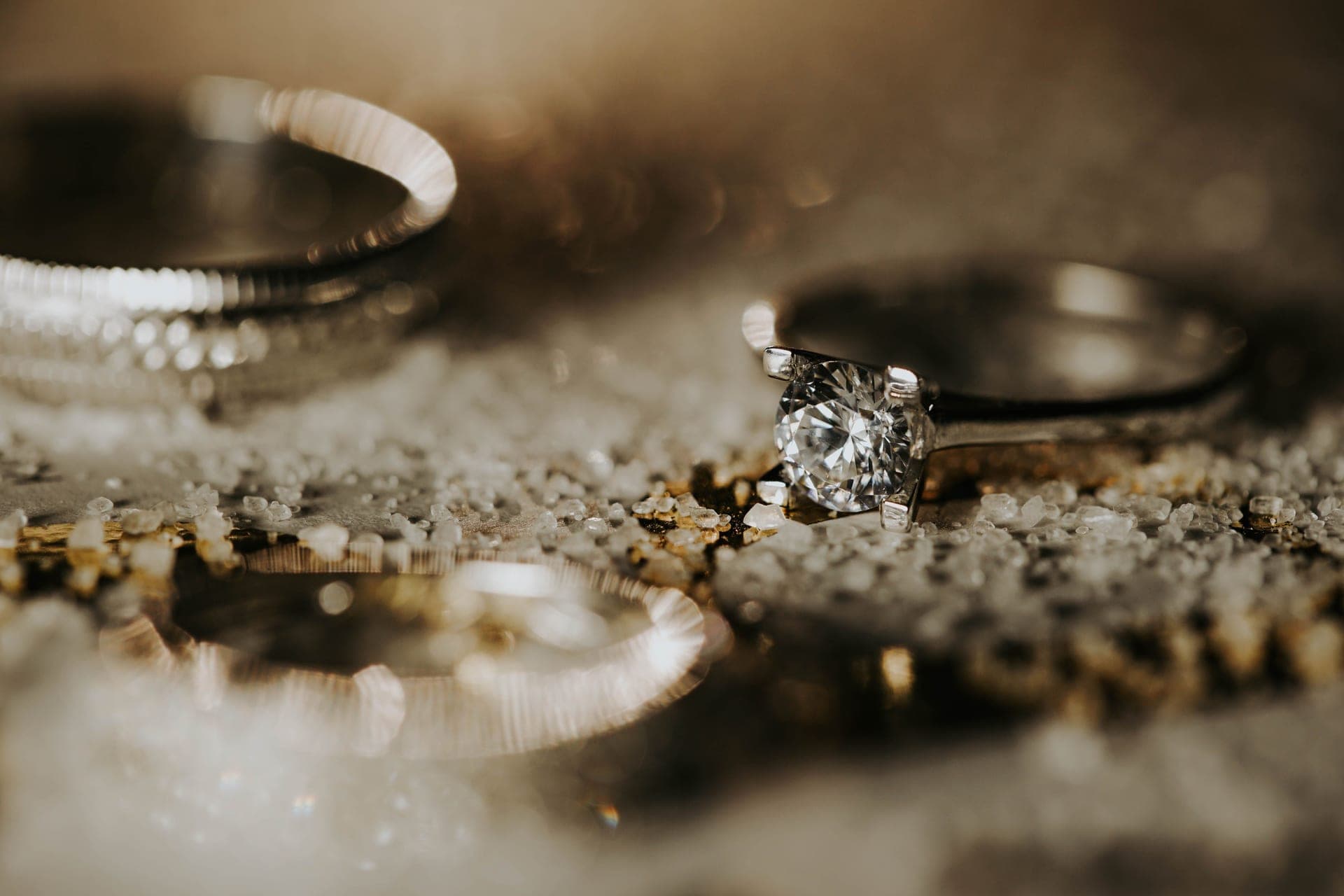
Cut - the one that matters
Cut is not the shape (round, oval, princess). It is the quality of the proportions, symmetry and polish - how well the facets are placed to catch light, bend it and send it back to your eye.
A poorly cut stone leaks light out of the bottom and looks dull no matter how flawless or colourless it is. A well-cut stone with visible inclusions and a slight tint can still look spectacular. If you are optimizing one thing, optimize cut.
It is also the one C that is entirely about human workmanship rather than geological luck, which is why it is the one that varies most between a cheap stone and a good one at the same nominal specs.
Color - graded on absence
Diamond color is graded from D (completely colourless) down through the alphabet as a faint yellow or brown tint increases. The scale starts at D rather than A for historical reasons.
The differences between adjacent grades are subtle and often invisible once a stone is set, particularly in yellow gold, which warms the appearance anyway. Paying for the top of the scale usually buys a distinction you cannot see.
Clarity - graded on inclusions
Clarity describes internal inclusions and surface blemishes, from Flawless down through VVS, VS, SI and I grades. Most inclusions in the middle grades are invisible without magnification.
The phrase worth knowing is eye-clean: a stone with inclusions you cannot see without a loupe. An eye-clean SI stone looks identical to a VVS stone on a hand and costs meaningfully less.
Carat - weight, not size
Carat is a unit of weight, not diameter. Because weight scales roughly with the cube of the dimensions, a stone twice the carat weight is nowhere near twice as wide across the face.
Price also rises sharply and unevenly with carat, with jumps at the round numbers people shop for. A stone just under a psychologically significant weight is usually disproportionately better value, and looks essentially identical.
| C | What it is | Visible impact | Price impact |
|---|---|---|---|
| Cut | Proportions, symmetry, polish | Highest | Moderate |
| Carat | Weight | Moderate - scales with the cube root | Highest |
| Color | Absence of tint | Low once set, especially in yellow gold | High |
| Clarity | Inclusions and blemishes | Low above eye-clean | High |
How to spend a fixed budget
- Buy the best cut you can. It is the only C that changes how the stone behaves in light.
- Drop to eye-clean clarity. Inclusions you cannot see are inclusions you are not buying.
- Drop a color grade or two, especially for a yellow gold setting.
- Then choose carat with what is left, and consider going just under a round number.
That order is close to the opposite of how stones are marketed, which tends to lead with carat because it is the easiest number to compare.
The 4Cs and non-diamond stones
The scale was built for diamonds. Applying it to moissanite - “D color VVS1 moissanite” - is industry convention rather than a like-for-like grade, since the stone is a different mineral with different optical behavior. Read those descriptions as a rough quality tier rather than as an equivalent grade.
Every pick in detail
What each one is actually made of, how long it realistically lasts in that material, who it is for and who should skip it.
1 · Best studs
Belacqua 1/2 Carat Lab-Grown Diamond Stud Earrings, 14K Yellow Gold
The first item here where nothing is a coating and nothing clouds. That is what the price is buying.
- What it is
- Lab-grown diamonds set in solid 14K yellow gold. Lab-grown diamonds are real diamonds - same carbon, same crystal structure, same Mohs 10 hardness. The gold is solid, not plated or filled.
- Realistic lifespan
- Effectively permanent. Mohs 10 stones in solid 14K gold is the only combination on this site with no wear-limited component at all.
- 0.5ct total
- Mohs 10
- solid 14K gold
What works
- Solid gold settings - no plating to wear off, ever
- Real diamonds at a fraction of mined-diamond pricing
- Nothing on this product has a countdown attached to it
What does not
- Lab-grown diamond resale is thin and prices have fallen steadily
- The most expensive earrings on the site by a wide margin
Skip it if: you are buying for resale or as a store of value. Lab-grown prices have been falling; buy these to wear for thirty years, which they will.
#ad how we make money · price as of October 22, 2026
Best for buying earrings once. Score 9.2/10 from published specifications.
2 · Best single stone
Carbon Atelier 1 Carat Lab-Grown Diamond Pendant, 14K Gold
A full carat of real diamond in solid gold. It is the most expensive thing we link to and the only one with genuinely nothing to replace.
- What it is
- One carat lab-grown diamond in solid 14K gold. Real diamond, solid gold, no coatings anywhere.
- Realistic lifespan
- Effectively permanent for both the stone and the setting.
- 1.0ct
- Mohs 10
- solid 14K gold
What works
- Solid gold chain and setting - nothing to plate, nothing to wear
- A carat of real diamond at a price mined stones cannot approach
What does not
- Lab-grown resale value is weak and has been declining
- A single large stone concentrates all the value in one prong-held place
Skip it if: you are buying an asset. If the money is meant to hold value, this is not the instrument - buy it because you want to wear a carat of diamond.
Best for a milestone piece bought once. Score 9.0/10 from published specifications.
3 · Best alternative
Moissanite Stud Earrings, 2.0ct D Color Equivalent, GRA Certified
The stone that solves the CZ problem. Hard enough to stay bright, priced far below a diamond, and honest about being moissanite.
- What it is
- Moissanite (silicon carbide) in 925 sterling silver with an 18K white gold plated finish, sold with a GRA report. Moissanite is its own mineral, not a diamond simulant pretending otherwise.
- Realistic lifespan
- Moissanite is 9.25 on the Mohs hardness scale against diamond's 10 and CZ's 8-8.5. In practice it holds its polish for decades where CZ clouds in a few years. The plated finish on the setting is the part that wears first.
- 2.0ct
- Mohs 9.25
- GRA report
What works
- Genuinely durable - moissanite does not go cloudy the way CZ does
- Higher refractive index than diamond, so it throws more colored fire
- Sold with a GRA report, which at least documents what the stone is
What does not
- The extra fire reads as 'not a diamond' to anyone who looks closely - some people want that, some do not
- GRA reports are not GIA reports; treat them as identification, not valuation
- The setting's white finish is plated and will wear
Skip it if: you want something with resale value. Moissanite's secondary market is thin. Buy it to wear, not to sell.
#ad how we make money · price as of October 22, 2026
Best for someone who wants stones that still sparkle in ten years. Score 8.4/10 from published specifications.
Common questions
Which of the 4Cs is most important?
Cut, by a distance. It determines how much light the stone returns, and a poorly cut stone looks dull regardless of its color and clarity grades.
What clarity grade should I buy?
The lowest grade that is eye-clean for the stone in question. Inclusions you cannot see without magnification do not affect how the piece looks, and you pay a lot for the grades above that line.
Do the 4Cs apply to lab grown diamonds?
Yes, identically. Lab-grown diamonds are graded on the same scale by the same laboratories, because they are the same material with the same optical properties.
Does carat mean size?
It means weight. Because weight scales with volume, a stone of twice the carat weight is only about 26% wider across the face. Face-up diameter is often a more useful number than carat weight.
Sources
Every specification and figure on this page traces to one of these. Where a source does not publish a number, the page says so rather than estimating one.
- 16 CFR 23.12 - Definition and misuse of the word 'diamond' — Sets when a laboratory-created diamond may be called a diamond and what disclosure is required.
- 16 CFR 23.25 - Misuse of 'ruby', 'sapphire', 'birthstone', 'gem', etc. — Governs how created and imitation stones must be described, including birthstones.
- GIA Gem Encyclopedia and gemological education — Reference source for gemstone hardness, species and treatment terminology.
Read next
- Lab grown vs natural diamonds
The same grading, very different prices.
- Settings explained
The part of the purchase the 4Cs do not cover.
- Diamond alternatives compared
When the 4Cs stop being the right frame.
- Best jewelry under $500
Where these decisions become live.