Care
Does Gold Filled Jewelry Tarnish?
No. But it does two other things people call tarnishing, and only one of them can be fixed.
#ad — we earn a commission on qualifying Amazon purchases at no extra cost to you. How this site is funded. Prices are live and shown as of October 22, 2026.
The short answer
No - gold-filled jewelry cannot tarnish, because its surface is solid karat gold and gold does not form a sulfide film. What people mistake for tarnish is either a removable dull film of skin oil and soap, or genuine wear-through at a friction point exposing the brass core, which is permanent.
What to buy
| # | Pick | Material | Score | Price |
|---|---|---|---|---|
| 1 |  Connoisseurs Extra Large Polishing Cloth, 14x14in A two-layer cloth is all a dull gold-filled chain needs, and the only tool that cannot overdo it Top pick | Impregnated polishing cloth, 14x14in. Two-layer cloths carry a mild polishing compound in the inner layer and a clean buffing surface outside.Best everyday fix | 8.5/10 | |
| 2 |  Weiman Fine Jewelry Cleaner Liquid with Brush A gold-safe liquid with a brush, for a chain with a year of film in the links rather than on the surface | Liquid jewelry cleaner with an integrated brush, formulated for gold, platinum and precious stones.Best deeper clean | 7.6/10 | |
| 3 |  Kooljewelry 14k Gold Filled Cable Chain Necklace The replacement answer when a plated chain has worn through - gold-filled carries 1/20th of its weight in gold instead of a 0.175-micron film | 14K gold-filled (1.5mm cable, 18in). Gold-filled means a bonded gold layer that is at least 5% of the item's total weight - a legal definition under the FTC jewelry guides, not a marketing phrase.Best gold-filled chain | 8.8/10 |
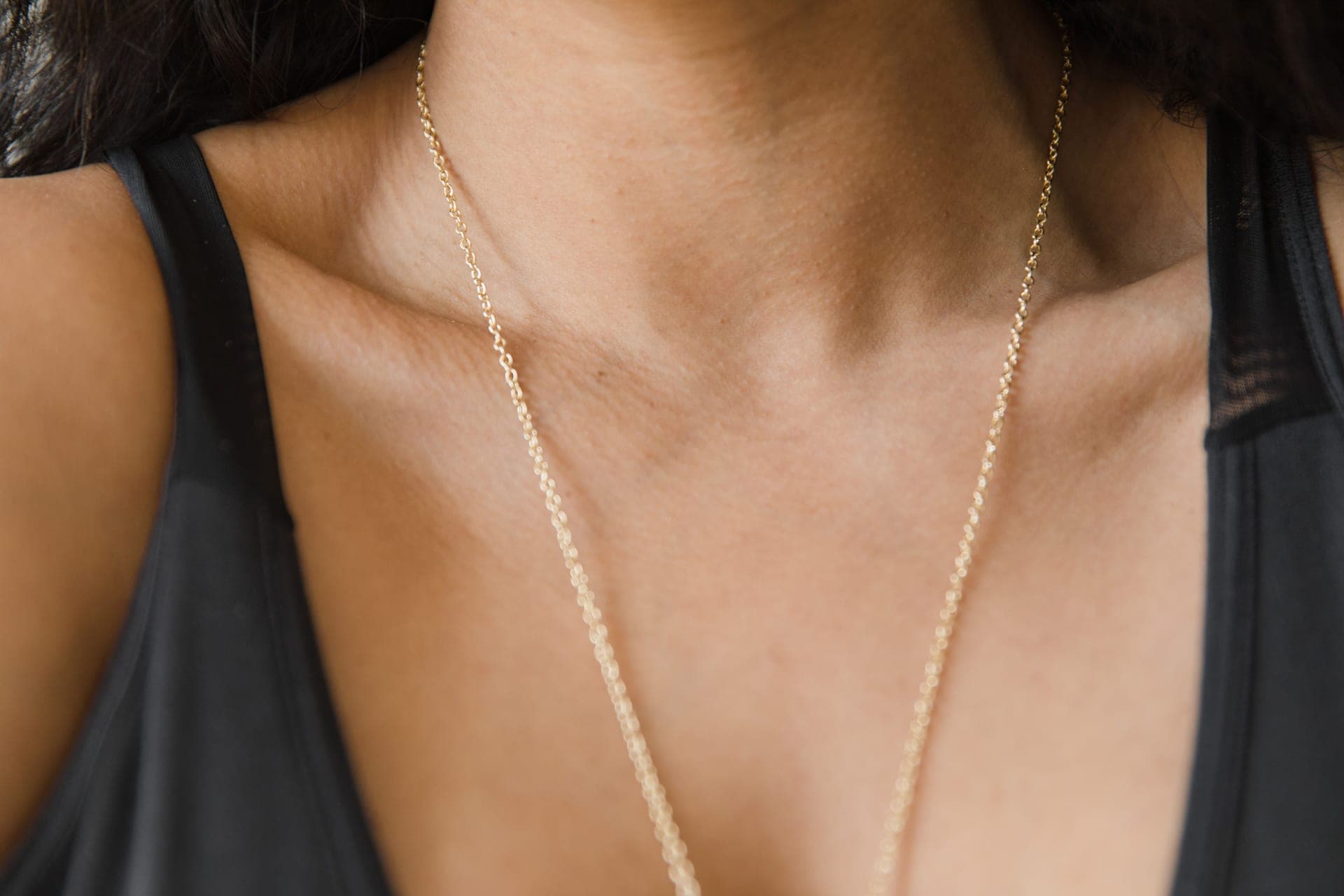
What tarnish is, and why gold is not part of it
Tarnish is a specific chemical reaction. Sulfur compounds in air, sweat and some foods react with silver to form silver sulfide, or with copper to form copper sulfide, and both are dark. It is a surface compound that forms out of the metal, which is why polishing removes a microscopic layer of the metal along with it.
Gold does not take part in that reaction at any karat normally used in jewelry. A gold-filled piece has a bonded layer of real karat gold on its outside - at least 1/20th, or 5%, of the weight of the metal in the whole article, which is an FTC threshold rather than a marketing phrase. The surface you touch is gold. So the answer to the question in the title is simply no, and that is the main reason gold-filled is the material this site recommends most often for daily wear.
The tier above it has no coating at all - gold filled vs solid gold - and the tier below it is a coating measured in fractions of a micron, which is what gold plated means. But two other things do happen to gold-filled jewelry over time, and both get called tarnishing. Telling them apart is the useful part, because one takes thirty seconds to fix and the other cannot be fixed at all.
The two things that actually happen
| Dull film | Wear-through | |
|---|---|---|
| What it is | Skin oil, soap, lotion and dust on the surface | The gold layer abraded away, exposing the core |
| What it looks like | Overall flat, grayish, low-shine - evenly across the piece | A specific patch going pink, coppery or gray |
| Where it appears | Everywhere, worst in links and crevices | One spot: clasp, hinge, inside a ring band, under a bracelet |
| How fast | Weeks of wear | Years, and only at friction points |
| Can it be fixed? | Yes - a cloth or warm soapy water | No - the gold at that spot is gone |
| Does it spread? | No | Yes, slowly, as the exposed area abrades further |
The diagnostic question is is it even or is it a patch. Evenly dull across the whole piece is film, every time. A pink or coppery patch at one high-friction point is wear-through, and that is the brass core showing - gold-filled cores are typically brass or jeweler's brass, which is a copper-zinc alloy.
Fixing the film, which is almost always what it is
A gold-filled chain that has gone flat after six months of wear needs a two-layer polishing cloth and about a minute. The inner layer carries a mild compound; the outer layer buffs. Work along the length of a chain rather than across it.
If the film is in the links rather than on them - which is what happens after a year of lotion and sunscreen - warm water with a drop of mild dish soap, a five-minute soak, a soft brush along the links and a full dry will do what the cloth cannot reach. A gold-safe liquid cleaner with a brush is the packaged version of the same thing. Full method in how to clean gold chains.
The important difference from plated jewelry: gold-filled tolerates all of this. A soak, a soft brush and a polishing cloth are safe on gold-filled because there is a meaningful thickness of gold there to survive them. Do any of the three to a plated chain and you will take the coating off, which is why how to clean gold plated jewelry is a separate and much more restrictive page.
Wear-through, and why it takes years
Gold-filled wears through eventually, at the places where metal rubs continuously against something. In rough order of how fast:
- Inside a ring band - the worst position in jewelry. A gold-filled ring worn daily may show its core in two to five years.
- A bracelet's underside - a wrist drags on a desk all day. Five to fifteen years.
- A clasp and the back of a chain - friction against a collar. Often the first visible spot on a necklace.
- A hinge or closure on an earring - metal sliding on metal, but a tiny area and very little force.
- Earring faces and pendant surfaces - effectively never. These are the positions where gold-filled genuinely lasts decades.
That ordering is why this site recommends gold-filled confidently for chains, pendants and earrings and more carefully for rings. It is also why the numbers quoted for gold-filled lifespan vary so widely between sources: 10 to 30 years is a chain figure, not a ring figure.
What makes it worse, and what makes it last
Nothing here is complicated, and the difference between a casual owner and a careful one is measured in years:
- Chlorine is the one real chemical threat. Pool water attacks the gold layer and the exposed core at any pinhole. Take gold-filled off for swimming.
- Put it on last. Perfume, hairspray and lotion are alcohol- and acid-bearing, and they accelerate dulling.
- Rinse and dry after sweat. Sweat salts are what sit in the links and become film.
- Store it dry and apart. Chains abrade each other. Gold is soft; brass is harder than gold.
- Skip the anti-tarnish strips. They absorb airborne sulfur, which is a silver problem. On gold-filled they do nothing - correct use is in how to store jewelry.
If it has worn through
There is no home repair. The gold at that point is gone, and polishing removes more of what remains around it. A jeweler can electroplate over the exposed area, which puts a 0.175-micron-class coating on a spot that used to carry twenty times that - so it is a cosmetic patch that will wear again quickly, and on an inexpensive chain it costs more than the chain.
The honest answer is that a gold-filled piece which has worn through has given you its service life, and that service life was probably a decade or more. If what you actually want is a gold tone that never does this at a plated price, the realistic options are in gold plated that won't tarnish. Replace it, and note that this is the exact failure a plated chain delivers in year two - the comparison is in gold filled vs gold plated.
Every pick in detail
What each one is actually made of, how long it realistically lasts in that material, who it is for and who should skip it.
1 · Best everyday fix
Connoisseurs Extra Large Polishing Cloth, 14x14in
The safest cleaning tool here and the one to reach for first. Ninety percent of jewelry cleaning should be this and nothing else.
- What it is
- Impregnated polishing cloth, 14x14in. Two-layer cloths carry a mild polishing compound in the inner layer and a clean buffing surface outside.
- Realistic lifespan
- Until it is black. A treated cloth is consumable - and it should never be washed, because washing removes the compound that makes it work.
- 14x14in
- impregnated
- two-layer
What works
- Safe on far more materials than any liquid or machine here
- Regular light use prevents the tarnish that would otherwise need abrasive polish
- Costs less than a cheap chain
What does not
- Do not wash it - washing removes the compound and turns it into a rag
- Cannot reach inside chain links or behind set stones
Skip it if: you need to clean pearls. Wipe pearls with a plain damp soft cloth and nothing else - no compound, no polish, no dip.
#ad how we make money · price as of October 22, 2026
Best for routine upkeep on almost everything - silver, gold, gold-filled and steel. Score 8.5/10 from published specifications.
2 · Best deeper clean
Weiman Fine Jewelry Cleaner Liquid with Brush
The brush is the difference. Dip cleaners loosen the film; a brush is what actually removes it from behind a setting.
- What it is
- Liquid jewelry cleaner with an integrated brush, formulated for gold, platinum and precious stones.
- Realistic lifespan
- Consumable. The brush outlasts the bottle.
- with brush
- gold + platinum
- liquid
What works
- The integrated brush reaches the underside of a setting, which is where the dullness actually lives
- Formulated for precious metal rather than as a general household cleaner
What does not
- Same restriction as every dip: not for pearls, opals, turquoise, coral or amber
- Brushing plated pieces accelerates coating wear
Skip it if: your rings are plated. Brushing a plated ring is a fast way to wear through the coating at the high points.
#ad how we make money · price as of October 22, 2026
Best for gold and platinum settings where dirt collects under the stone. Score 7.6/10 from published specifications.
3 · Best gold-filled chain
Kooljewelry 14k Gold Filled Cable Chain Necklace
The clearest gold-filled starter chain in the set - the listing says gold-filled in those words, which is most of what you are paying for.
- What it is
- 14K gold-filled (1.5mm cable, 18in). Gold-filled means a bonded gold layer that is at least 5% of the item's total weight - a legal definition under the FTC jewelry guides, not a marketing phrase.
- Realistic lifespan
- Gold-filled worn daily typically holds its color 10-30 years. Assumes daily wear, removal for swimming, and no repeated chemical contact.
- 1.5mm cable
- 14K gold-filled
- 18in
What works
- Unambiguous gold-filled labeling - the material claim is checkable
- Cable link is the most repairable chain style if a link ever opens
- Gold-filled tolerates sweat and daily wear in a way plating does not
What does not
- Costs roughly twice a plated chain of the same look
- 1.5mm is dainty; it will not read as a statement chain
Skip it if: you change chains with the season. For a one-season trend piece a $12 plated chain is the rational purchase and we would not talk you out of it.
#ad how we make money · price as of October 22, 2026
Best for a first chain you want to still own in ten years. Score 8.8/10 from published specifications.
Common questions
Does gold filled jewelry tarnish?
No. Tarnish is a sulfide film that forms on silver and copper, and the surface of a gold-filled piece is solid karat gold - at least 1/20th of the item's weight. It can dull from skin oil and soap, which wipes off, and it can wear through at friction points, which does not.
Why does my gold filled chain look dull?
Because a film of skin oil, soap residue, lotion and dust has built up on the surface and is scattering light. A two-layer polishing cloth fixes it in about a minute; if the film is between the links, a warm soapy soak and a soft brush will reach it.
How long does gold filled jewelry last?
It depends entirely on position. A chain, pendant or earring: 10 to 30 years. A bracelet: 5 to 15. A ring worn daily: 2 to 5, because the inside of a band is the highest-abrasion place in jewelry.
Can gold filled jewelry turn your skin green?
Only after it has worn through. The core is typically brass - a copper-zinc alloy - and copper salts are what produce the green mark. On an intact gold-filled piece the core never touches skin. See why jewelry turns skin green.
Can you shower or swim in gold filled jewelry?
Showering occasionally is fine, though soap residue dulls it and drying afterwards matters. Swimming is not: chlorinated and salt water attack the gold layer and reach the core through any pinhole. Take it off for the pool.
Sources
Every specification and figure on this page traces to one of these. Where a source does not publish a number, the page says so rather than estimating one.
- 16 CFR 23.3 - Misrepresentation as to gold content (FTC Jewelry Guides) — Defines the gold-plate minimum (0.175 microns), heavy gold electroplate (2.5 microns) and the gold-filled 1/20th-by-weight threshold.
- 16 CFR 23.4 - Misuse of the word 'vermeil' — Vermeil requires a sterling silver base, gold of at least 10 karat fineness, and a minimum 2.5 microns throughout.
- 16 CFR Part 23 - Guides for the Jewelry, Precious Metals, and Pewter Industries — The full FTC Jewelry Guides, which govern every material claim quoted on this site.
- 16 CFR 23.5 - Misrepresentation as to silver content — 'Sterling' requires at least 925/1000ths pure silver; 'coin silver' at least 900/1000ths.
- 16 CFR 23.11 - Misuse of 'corrosion proof', 'rust resistant', etc. — Governs the durability claims routinely made in jewelry listings.
- 16 CFR Part 23 - Guides for the Jewelry, Precious Metals, and Pewter Industries — The full FTC Jewelry Guides, which govern every material claim quoted on this site.
- Copper Development Association - alloy C26000 (cartridge brass) — The CDA's own classification of the commonest brass: wrought, family 'Copper-Zinc Alloys (Yellow Brasses)'. Brass is copper plus zinc - the copper is the part that reacts with skin.
- Amazon Associates Program Operating Agreement — Why every price on this site is pulled live and date-stamped rather than typed in.
Read next
- What is gold filled jewelry?
The 1/20th-by-weight threshold, and what it buys.
- Gold filled vs gold plated
Twenty times the gold, and what that means in years.
- How to clean gold chains
The full method, per construction.
- Gold plated that won't tarnish
The same question asked about the thinner coating.